
The Intelligence Product...
Is a Thinking Artifact

The intelligence product is often misunderstood. Too many analysts treat the bulletin, assessment, or study as a writing assignment, a format requirement, or a dissemination vehicle. It is none of those things at its core. An intelligence product is a thinking artifact. It is the visible remainder of disciplined judgment under uncertainty.
That distinction matters because the analyst’s real task is not to move information from collection to consumer. It is to transform incomplete, ambiguous, uneven, and sometimes deceptive information into a judgment that can survive scrutiny. The product is the final expression of that transformation. If the thinking is shallow, the product will be shallow, no matter how clean the template looks. If the reasoning is disciplined, even a short bulletin can carry analytic weight.
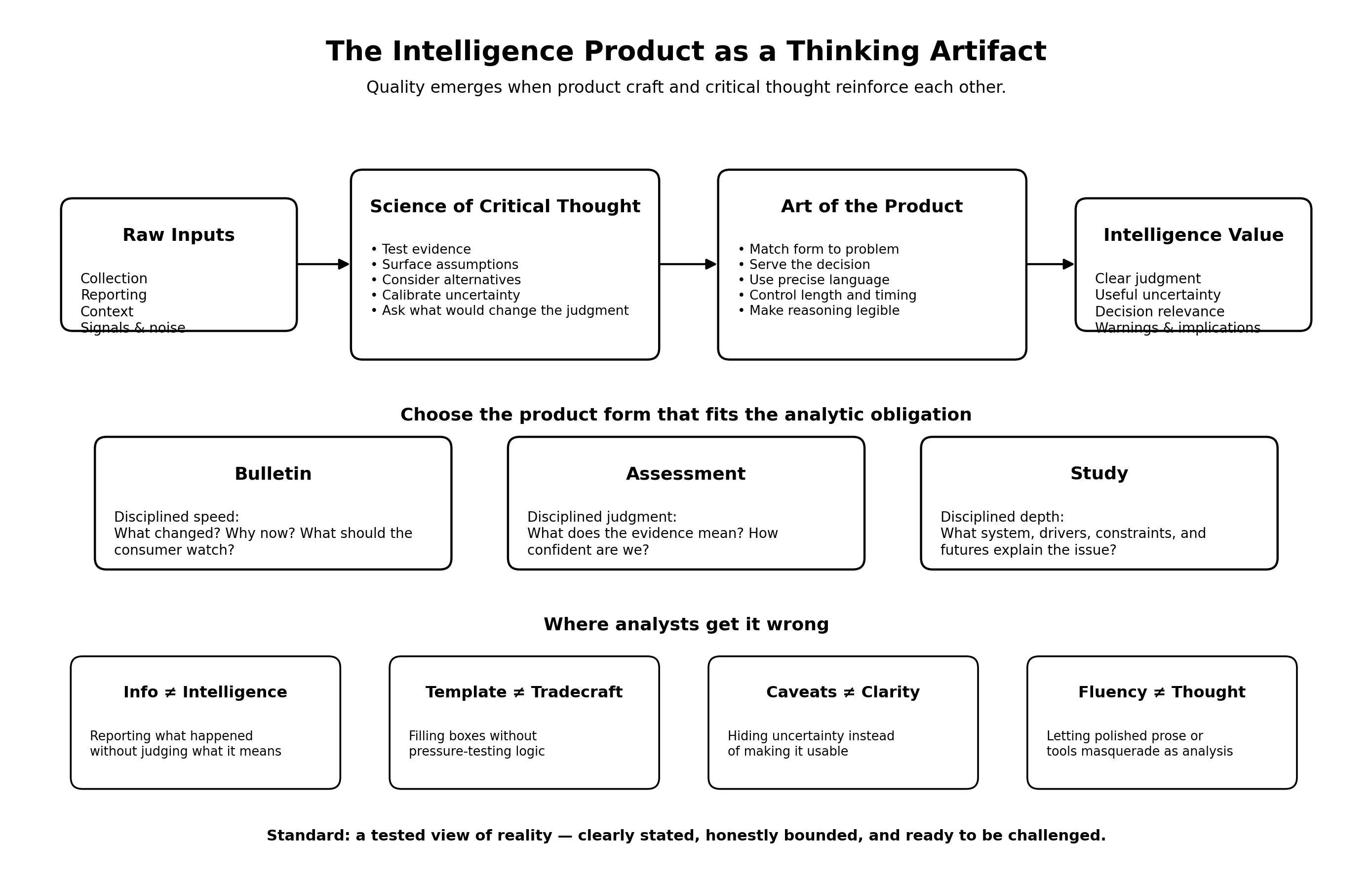
The art of intelligence production lies in form, timing, language, and audience. The science lies in critical thought: evidence evaluation, assumption testing, bias mitigation, uncertainty calibration, alternative analysis, and intellectual humility. The best analysts understand both. The weakest analysts confuse one for the other.
The Intelligence Community’s own analytic standards make this point clearly. ICD 203 says analytic standards govern the production and evaluation of analytic products and require analysts to pursue excellence, integrity, and rigor in analytic thinking and work practices. It also says those standards must be applied in a way appropriate to the product’s purpose, source base, timeline, and customer. In other words, tradecraft is not a decorative layer added after writing. It is the discipline that shapes the product from the beginning.
The Art: Matching the Product to the Decision
A bulletin is not an assessment. An assessment is not a study. Each has a different obligation.
The bulletin is the art of disciplined speed. It should answer: What changed? Why does it matter now? What should the consumer watch next? A bulletin that merely reports an event is not intelligence; it is news with a government seal. A good bulletin compresses time without compressing judgment. It gives the reader the minimum necessary context, the clearest possible significance, and the most honest statement of uncertainty.
The assessment is the art of judgment. It must do more than describe the world; it must take a position about what the evidence means. It should tell the consumer what is known, what is assessed, what is assumed, how confident the analyst is, and what would change the judgment. The assessment is where many analysts become timid. They hide behind phrasing, bury the key judgment, or mistake balance for courage. Balance is not the absence of judgment. Balance is judgment reached after alternatives have been honestly considered.
The study is the art of depth. It asks not only what is happening, but why it is happening, how it developed, what systems sustain it, and where it may go. A study should reveal structure: drivers, constraints, actors, incentives, vulnerabilities, indicators, and possible futures. A weak study is a long assessment. A strong study gives the consumer a deeper mental model.
The analyst must know which product the problem deserves. Some issues require speed. Some require judgment. Some require excavation. Analysts get into trouble when they use the wrong form for the wrong problem: a bulletin that tries to be a dissertation, an assessment that refuses to assess, or a study that buries the reader in background without producing insight.
The Science: Critical Thought Under Pressure
Critical thinking in intelligence is not a slogan. It is not “being objective” in some vague personal sense. It is a disciplined sequence of mental acts: orienting to the problem, framing the question, identifying assumptions, testing evidence, considering alternatives, calibrating uncertainty, synthesizing judgment, and reflecting on what could be wrong.
That is where the science enters. Human beings are not natural critical thinkers under pressure. We are pattern-seeking, story-building, closure-hungry creatures. Richards Heuer’s classic CIA work on the psychology of intelligence analysis was built around this problem: analysts must make judgments from incomplete and ambiguous information, while their own cognitive processes shape how they interpret that information. (CIA)
The uploaded critical-thinking material makes the same point in practical terms: serious analysis depends on disciplined habits of mind, not mere mental activity. The analyst must protect thinking through structure, humility, curiosity, and integrity, especially when institutions reward speed, certainty, and narrative comfort. The Precision–Curiosity framework’s emphasis on “micro-protocols” is especially useful here: small, repeatable cognitive moves can interrupt confirmation bias, narrative lock-in, and pressure-driven conclusions before they harden into finished products.
The science of critical thought is also probabilistic. Intelligence rarely deals in certainty. It deals in likelihood, confidence, evidence quality, and competing explanations. The United Kingdom’s intelligence assessment guidance separates probability from analytical confidence: probability concerns the likelihood that a judgment is true, while confidence concerns the strength and stability of the foundation beneath that judgment. That distinction is essential. A judgment can be likely but low-confidence if the evidence base is thin, volatile, or indirect. (GOV.UK)
This is where analysts often become careless. They use words like “likely,” “possibly,” “almost certainly,” or “low confidence” as if the reader will intuit the same meaning the analyst intends. They will not. The UK guidance explicitly uses probability yardsticks to prevent vague estimative language from creating false understanding, while also warning against over-precise numerical expression when the underlying judgment is not quantitative. (GOV.UK)
The analyst’s responsibility is not to sound certain. It is to be clear about the degree, basis, and fragility of the judgment.
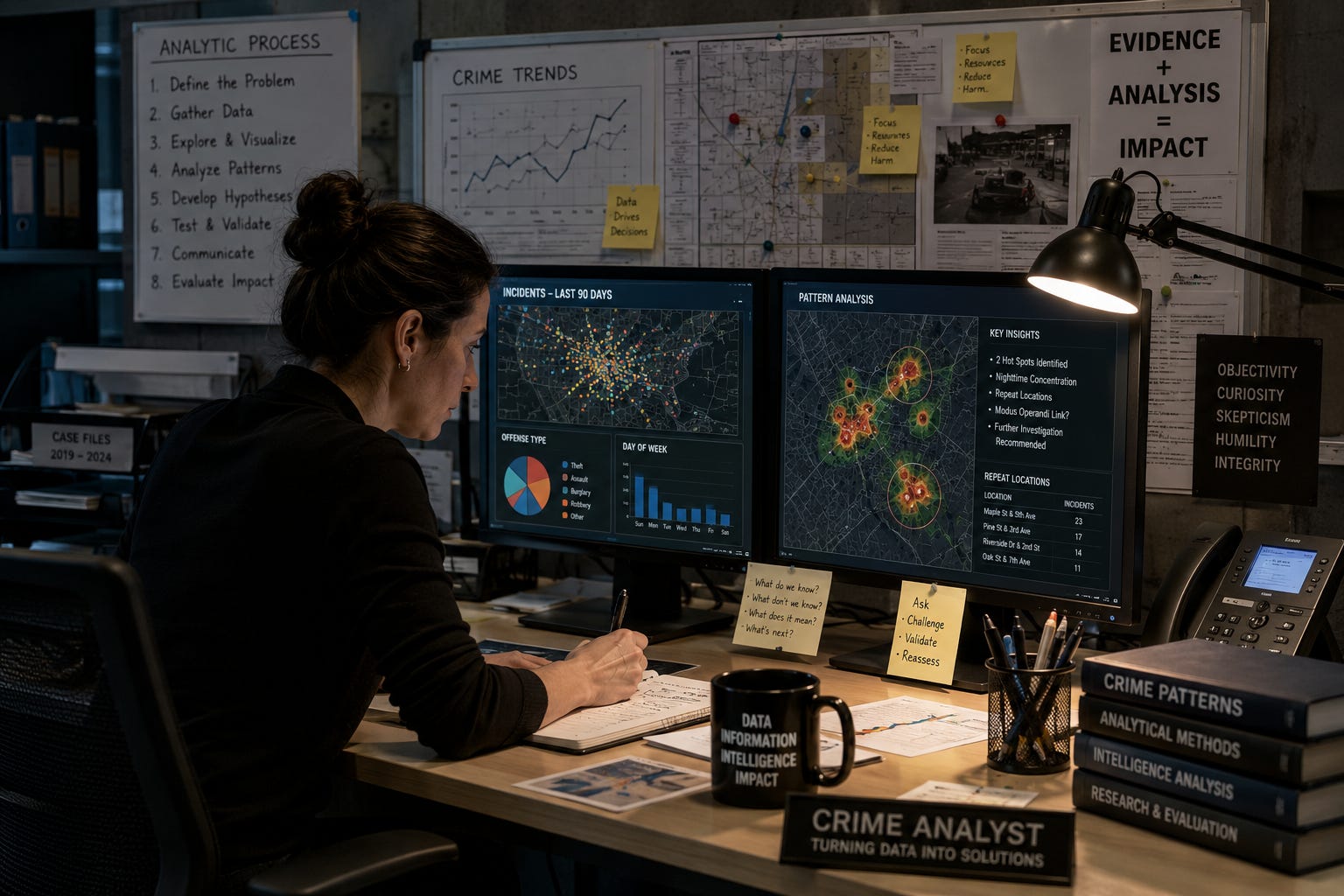
Where Analysts Are Getting It Wrong
Analysts are getting it wrong first by confusing information with intelligence. Collection is not analysis. Description is not judgment. Chronology is not insight. A product that says what happened but does not explain what it means has not completed the analytic act.
Second, analysts are writing products instead of building arguments. The finished product may be prose, but the underlying work must be argumentative: claim, evidence, reasoning, assumptions, alternatives, uncertainty, implications. ICD 203 requires analysts to distinguish intelligence information from assumptions and judgments, state key assumptions when they are central to the argument, explain the implications if those assumptions are wrong, and identify indicators that would alter judgments. When analysts fail to do this, they force the consumer to reverse-engineer the logic.
Third, analysts are over-caveating instead of clarifying. Caveats are necessary, but they can become a form of self-protection. The reader does not need a fog bank of disclaimers. The reader needs to know which uncertainties matter, why they matter, and how they affect the judgment. The old wisdom attributed to Colin Powell remains one of the cleanest formulations of analytic discipline: tell the consumer what you know, what you do not know, and what you think, while always distinguishing among them. (Army University Press)
Fourth, analysts mistake templates for tradecraft. A product can have the right boxes, headings, sourcing language, and confidence statements while still being analytically weak. Tradecraft is not compliance theater. It is not something stapled to the product after the conclusion has already been chosen. Army University Press makes this point bluntly: analytic tradecraft standards should be treated as an ethos that reflects everything analysts do, not as a checklist applied after products have been developed. (Army University Press)
Fifth, analysts fall in love with their first coherent story. Narrative coherence is seductive because it feels like understanding. But the most dangerous analytic errors often come from stories that fit too well too early. The disciplined analyst asks: What else could explain this? What evidence would weaken my conclusion? Which assumption is carrying the most weight? What would I believe if my best source were wrong? What would an adversary want me to believe?
Sixth, analysts mishandle uncertainty. Some hide it. Some exaggerate it. Some express it so vaguely that it becomes meaningless. Others overcorrect by assigning numerical precision that the evidence does not deserve. The goal is calibrated honesty. A product should not erase uncertainty; it should make uncertainty usable.
Seventh, analysts under-serve the consumer. Relevance is not pandering. It is professional responsibility. The consumer does not need every interesting fact the analyst found. The consumer needs the judgment that bears on a decision, risk, opportunity, warning, or collection gap. An elegant product that does not help anyone decide, prepare, question, or act is an elegant failure.
Eighth, analysts treat dissent as friction rather than protection. Dissent slows the room down, but that is often precisely its value. Premature consensus is one of the great enemies of intelligence work. Alternative analysis is not a bureaucratic requirement; it is the immune system of the product.
Ninth, analysts fail to revisit their judgments. Forecasting and assessment should not be fire-and-forget exercises. Judgments should be tracked, updated, scored where possible, and studied after the fact. IARPA’s Aggregative Contingent Estimation program was built around improving the accuracy, precision, and timeliness of intelligence forecasts through better elicitation, weighting, aggregation, and empirical testing against real events. (IARPA) That spirit matters beyond formal forecasting tournaments. Analysts need feedback loops. Without them, confidence grows faster than accuracy.
Finally, analysts are beginning to outsource too much cognition to tools. Technology can summarize, sort, translate, visualize, and accelerate. It cannot assume responsibility for judgment. The danger is not that artificial intelligence will replace analysts. The danger is that analysts will allow fluency, speed, and clean formatting to masquerade as thought.
What Better Looks Like
A strong intelligence product should make the analyst’s mind visible without making the product cumbersome. The reader should be able to see the central judgment, the evidence behind it, the assumptions beneath it, the uncertainty around it, the alternatives considered, and the implications that follow.
Before releasing any bulletin, assessment, or study, an analyst should be able to answer seven questions:
What is my main judgment?
What evidence matters most?
What assumptions am I relying on?
What uncertainty remains, and why?
What alternative explanation deserves attention?
What would change my mind?
Why does this matter to the consumer now?
That is not a writing checklist. It is a thinking discipline.
The best intelligence products are not necessarily the longest, most polished, or most heavily sourced. They are the most honest. They reduce uncertainty without pretending to eliminate it. They make judgment clear without making it brittle. They respect the consumer’s need for usefulness without surrendering the analyst’s obligation to truth.
This is the art and science of the intelligence product: craft the form so the judgment can be received; discipline the thought so the judgment can be trusted.
Analysts get it wrong when they forget that distinction. They get it right when they understand that every product is more than a document. It is a public record of how carefully, courageously, and honestly the analyst was willing to think.
Conclusion: The Product Is the Proof of Thought
The intelligence product is where analytic discipline either becomes visible or collapses into performance. A bulletin, assessment, or study is not merely a vehicle for information. It is the final expression of how an analyst thinks, how honestly that analyst handles uncertainty, how carefully evidence has been weighed, and how courageously judgment has been rendered. The product is the place where craft and cognition meet.
That is why the art of the intelligence product cannot be separated from the science of critical thought. The art gives the product shape. It determines how the analyst frames the issue, orders the evidence, speaks to the consumer, controls language, and delivers judgment at the right level of detail. The science gives the product integrity. It forces the analyst to test assumptions, examine alternatives, calibrate confidence, recognize bias, and distinguish what is known from what is inferred. One without the other is inadequate. Art without disciplined thinking becomes elegant storytelling. Science without craft becomes inaccessible, sterile, and unusable. The analyst’s task is to fuse both.
Where analysts most often get it wrong is not in failing to work hard. Most analysts work very hard. They read, collect, brief, write, revise, coordinate, and respond to shifting demands. The problem is that effort is too often spent in the wrong place. Analysts polish prose before they pressure-test logic. They satisfy formats before they sharpen judgments. They produce summaries when the mission requires assessment. They cite evidence without explaining why that evidence matters. They use uncertainty language without making uncertainty useful. They become trapped by the first plausible narrative and then defend it through selective sourcing, institutional consensus, or vague caveats.
The failure is not usually a lack of intelligence. It is a failure of analytic discipline.
A good intelligence product does not simply tell the reader what happened. It tells the reader what matters, why it matters, what is likely to happen next, how confident the analyst is, and what could change the judgment. It does not hide behind cautious language, but neither does it overstate what the evidence can bear. It does not pretend uncertainty is weakness. It treats uncertainty as a professional obligation to be clarified, bounded, and communicated.
The strongest products make the analyst’s reasoning legible. The reader should not have to guess how the conclusion was reached. The product should reveal the chain of judgment: the key evidence, the central assumptions, the alternative explanations, the confidence level, the indicators to watch, and the implications for the consumer. This does not mean every product must be long. A one-page bulletin can show disciplined reasoning. A fifty-page study can fail to do so. Length is not rigor. Detail is not insight. Format is not tradecraft.
This is especially important because intelligence analysis operates in an environment that punishes hesitation and rewards speed. Consumers often want answers before the evidence is complete. Institutions often want consensus before dissent has been fully explored. Production cycles often reward output more than reflection. In that environment, critical thought is not a luxury. It is the analyst’s main defense against becoming a courier of noise, bias, or premature certainty.
Critical thinking must therefore become more than an individual virtue. It must become a production habit. Analysts should not wait until the end of a draft to ask whether the logic holds. They should build that discipline into the beginning of the process. Before writing, they should clarify the intelligence question. Before judging, they should identify assumptions. Before coordinating, they should consider alternatives. Before publishing, they should ask what would make the judgment wrong. Small, repeatable thinking practices are often what prevent large analytic failures. The discipline of pausing, testing, reframing, and challenging the first explanation is central to serious analysis.
The best analysts are not those who sound the most certain. They are those who are most honest about what the evidence permits. They understand that confidence must be earned, not performed. They know the difference between a strong judgment and a loud one. They are willing to say, “This is what we assess, this is why we assess it, this is how confident we are, and this is what would change our view.” That kind of clarity is not weakness. It is professional strength.
The intelligence product should ultimately help the consumer think better, not merely know more. A product that adds information but does not improve understanding has limited value. A product that helps the consumer see risk, opportunity, deception, intent, capability, vulnerability, or change has done its job. The analyst’s purpose is not to impress the reader with how much has been collected. The purpose is to reduce confusion in a way that supports better decisions.
This is why analysts must resist the temptation to confuse activity with contribution. More reporting is not always better analysis. More sourcing is not always better evidence. More caveats are not always better accuracy. More coordination is not always better judgment. The value of an intelligence product rests on disciplined selection: choosing the right question, the right evidence, the right level of confidence, the right language, and the right implications.
The profession also has to be honest about a growing danger: the easier production becomes, the easier it is to mistake fluency for thought. Modern tools can accelerate research, summarize large volumes of data, and help structure drafts. But no tool can relieve the analyst of responsibility for judgment. A cleanly written product can still be analytically empty. A fast answer can still be wrong. A plausible paragraph can still rest on weak evidence. The future of intelligence analysis will not belong to analysts who merely produce faster. It will belong to those who can think more clearly under pressure and use tools without surrendering cognition to them.
In the end, the intelligence product is an ethical act as much as an analytic one. It asks the analyst to be fair with evidence, transparent with uncertainty, alert to bias, respectful of dissent, and loyal to truth over comfort. That is not easy. It requires humility without timidity, confidence without arrogance, imagination without speculation, and discipline without rigidity.
The art of the intelligence product is making judgment useful.
The science of critical thought is making judgment trustworthy.
The analyst who masters both gives the consumer something more valuable than information. They give them a tested view of reality, clearly stated, honestly bounded, and ready to be challenged. That is the standard. That is the craft. And that is where the profession must keep returning whenever speed, volume, bureaucracy, or technology threatens to pull analysis away from its central purpose: clear thinking in service of consequential decisions.
Absolutely — here is a polished back-matter package you can use with the article. I organized the reading list around the article’s core themes: intelligence-product craft, critical thinking, uncertainty, forecasting, analytic standards, crime analysis, and law-enforcement intelligence practice. ODNI’s ICD 203 is especially relevant because it frames analytic quality around rigor, source quality, uncertainty, assumptions, alternatives, relevance, clear argumentation, accuracy, and effective visuals; PHIA guidance is useful because it separates probability language from analytical confidence; and BJA, NCIRC, and IACA resources help connect the article to crime-analysis and public-safety practice.
Reading and Resources List
Intelligence Analysis, Analytic Standards, and Product Tradecraft
Central Intelligence Agency. (2009). A tradecraft primer: Structured analytic techniques for improving intelligence analysis. https://www.cia.gov/resources/csi/static/Tradecraft-Primer-apr09.pdf
Clark, R. M. (2022). Intelligence analysis: A target-centric approach (7th ed.). CQ Press. https://collegepublishing.sagepub.com/products/intelligence-analysis-7-274957
Heuer, R. J., Jr. (1999). Psychology of intelligence analysis. Center for the Study of Intelligence. https://www.cia.gov/resources/csi/books-monographs/psychology-of-intelligence-analysis-2/
Kent, S. (1964). Words of estimative probability. Studies in Intelligence, 8(4), 49–65. https://www.cia.gov/resources/csi/studies-in-intelligence/archives/vol-8-no-4/words-of-estimative-probability/
Lowenthal, M. M. (2023). Intelligence: From secrets to policy (9th ed.). CQ Press. https://collegepublishing.sagepub.com/products/intelligence-9-268258
Marrin, S. (2012). Evaluating the quality of intelligence analysis: By what (mis) measure? Intelligence and National Security, 27(6), 896–912. https://doi.org/10.1080/02684527.2012.699290
Office of the Director of National Intelligence. (2015, January 2). Intelligence Community Directive 203: Analytic standards. https://www.dni.gov/files/documents/ICD/ICD-203.pdf
Office of the Director of National Intelligence. (2017, January 9). Intelligence Community Directive 208: Maximizing the utility of analytic products. https://www.dni.gov/files/documents/ICD/ICD-208-Maximizing-the-Utility-of-Analytic-Products-2017-01-09.pdf
Office of the Director of National Intelligence. (2024, December 2). Intelligence Community Standard 206-01: Publicly available information, commercially available information, and open source intelligence. https://www.dni.gov/files/documents/ICD/ICS-206-01.pdf
Pherson, R. H., & Heuer, R. J., Jr. (2019). Structured analytic techniques for intelligence analysis (3rd ed.). CQ Press. https://us2.sagepub.com/en-us/nam/structured-analytic-techniques-for-intelligence-analysis/book255432
Schmor, R. W., & Kwoun, J. S. (2021). Analytic tradecraft standards: An opportunity to provide decision advantage for Army commanders. Military Review, 101(2), 89–95. https://www.armyupress.army.mil/Journals/Military-Review/English-Edition-Archives/March-April-2021/Kwoun-Tradecraft-Standards/
Sinclair, R. S. (2010). Thinking and writing: Cognitive science and intelligence analysis (2nd ed.). Center for the Study of Intelligence. https://www.cia.gov/resources/csi/books-monographs/thinking-and-writing/
Treverton, G. F., & Gabbard, C. B. (2008). Assessing the tradecraft of intelligence analysis. RAND Corporation. https://www.rand.org/content/dam/rand/pubs/technical_reports/2008/RAND_TR293.pdf
Critical Thinking, Uncertainty, and Forecasting
Facione, P. A. (2023). Critical thinking: What it is and why it counts. Insight Assessment. https://insightassessment.com/wp-content/uploads/2023/12/Critical-Thinking-What-It-Is-and-Why-It-Counts.pdf
Friedman, J. A., & Zeckhauser, R. (2012). Assessing uncertainty in intelligence. Intelligence and National Security, 27(6), 824–847. https://doi.org/10.1080/02684527.2012.708275
Intelligence Advanced Research Projects Activity. (n.d.). Aggregative Contingent Estimation. Retrieved May 11, 2026, from https://www.iarpa.gov/research-programs/ace
Kahneman, D. (2011). Thinking, fast and slow. Farrar, Straus and Giroux. https://us.macmillan.com/books/9780374533557/thinkingfastandslow/
Moore, D. T. (2007). Critical thinking and intelligence analysis (2nd printing with revisions). National Defense Intelligence College. https://www.ialeia.org/docs/Critical_Thinking_and_Intelligence_Analysis_Copy.pdf
Paul, R., & Elder, L. (2006). The miniature guide to critical thinking: Concepts and tools (4th ed.). Foundation for Critical Thinking. https://www.criticalthinking.org/files/Concepts_Tools.pdf
Pherson, R. H. (2013). The five habits of the master thinker. Journal of Strategic Security, 6(3), 54–60. https://doi.org/10.5038/1944-0472.6.3.5
Professional Head of Intelligence Assessment. (2025, March 24). Explaining uncertainty in UK intelligence assessment. GOV.UK. https://www.gov.uk/government/publications/explaining-uncertainty-in-uk-intelligence-assessment/explaining-uncertainty-in-uk-intelligence-assessment
Professional Head of Intelligence Assessment. (2025, March 24). PHIA common analytical standards. GOV.UK. https://www.gov.uk/government/publications/phia-common-analytical-standards/phia-common-analytical-standards
Tetlock, P. E., & Gardner, D. (2015). Superforecasting: The art and science of prediction. Crown. https://www.penguinrandomhouse.com/books/227815/superforecasting-by-philip-e-tetlock-and-dan-gardner/
Crime Analysis, Law-Enforcement Intelligence, and Public Safety Practice
28 C.F.R. pt. 23. (2026). https://www.ecfr.gov/current/title-28/chapter-I/part-23
Atkin, H. (2011). Criminal intelligence: Manual for analysts. United Nations Office on Drugs and Crime. https://www.unodc.org/documents/organized-crime/Law-Enforcement/Criminal_Intelligence_for_Analysts.pdf
Boba, R. (2001). Introductory guide to crime analysis and mapping. U.S. Department of Justice, Office of Community Oriented Policing Services. https://portal.cops.usdoj.gov/resourcecenter/content.ashx/cops-w0273-pub.pdf
Bureau of Justice Assistance. (n.d.). Analysis toolkit. U.S. Department of Justice, Office of Justice Programs. Retrieved May 11, 2026, from https://bja.ojp.gov/program/it/analysis-toolkit
Bureau of Justice Assistance. (n.d.). National Criminal Intelligence Resource Center. U.S. Department of Justice, Office of Justice Programs. Retrieved May 11, 2026, from https://ncirc.bja.ojp.gov/
Carter, D. L. (2009). Law enforcement intelligence: A guide for state, local, and tribal law enforcement agencies (2nd ed.). U.S. Department of Justice, Office of Community Oriented Policing Services. https://portal.cops.usdoj.gov/ResourceCenter/content.ashx/cops-p064-pub.pdf
Clarke, R. V., & Eck, J. E. (2016). Crime analysis for problem solvers in 60 small steps. U.S. Department of Justice, Office of Community Oriented Policing Services. https://portal.cops.usdoj.gov/resourcecenter/content.ashx/cops-w0047-pub.pdf
Criminal Intelligence Coordinating Council. (2013). National Criminal Intelligence Sharing Plan: Building a national capability for effective criminal intelligence development and the nationwide sharing of intelligence and information (Version 2.0). Bureau of Justice Assistance. https://bja.ojp.gov/sites/g/files/xyckuh186/files/media/document/National_Criminal_Intelligence_Sharing_Plan_version_2.pdf
Department of Justice, Global Justice Information Sharing Initiative. (2010). Common competencies for state, local, and tribal intelligence analysts. Bureau of Justice Assistance. https://bja.ojp.gov/sites/g/files/xyckuh186/files/media/document/common_competencies_state_local_and_tribal_intelligence_analysts-2.pdf
Department of Justice, Global Justice Information Sharing Initiative. (2019). Analyst professional development road map (Version 2.0). Bureau of Justice Assistance. https://bja.ojp.gov/sites/g/files/xyckuh186/files/media/document/analyst_professional_development_road_map_2-00.pdf
Global Justice Information Sharing Initiative. (2007). Minimum criminal intelligence training standards for law enforcement and other criminal justice agencies in the United States (Version 2.0). U.S. Department of Justice, Bureau of Justice Assistance. https://bja.ojp.gov/sites/g/files/xyckuh186/files/media/document/minimum_criminal_intelligence_training_standards.pdf
Global Justice Information Sharing Initiative. (2011). Criminal intelligence resources guide: A collection of intelligence information sharing products and resources. U.S. Department of Justice, Bureau of Justice Assistance. https://bja.ojp.gov/sites/g/files/xyckuh186/files/media/document/criminal%20intelligence%20resources%20guide_compliant.pdf
Institute for Intergovernmental Research. (2023). 28 CFR Part 23 overview. National Criminal Intelligence Resource Center. https://28cfr.ncirc.gov/documents/28-CFR-Part-23-Overview.pdf
International Association of Crime Analysts. (n.d.). Fundamentals of crime analysis. Retrieved May 11, 2026, from https://www.iaca.net/fundamentals-of-crime-analysis
International Association of Crime Analysts. (n.d.). Publications. Retrieved May 11, 2026, from https://www.iaca.net/publications
International Association of Law Enforcement Intelligence Analysts, & Global Justice Information Sharing Initiative. (2012). Law enforcement analytic standards (2nd ed.). U.S. Department of Justice, Bureau of Justice Assistance. https://bja.ojp.gov/sites/g/files/xyckuh186/files/media/document/law_enforcement_analytic_standards_04202_combined_compliant.pdf
Santos, R. B. (2022). Crime analysis with crime mapping (5th ed.). SAGE Publications. https://collegepublishing.sagepub.com/products/crime-analysis-with-crime-mapping-5-270193
Author Bio
Dr. Charles M. Russo, Ph.D., is a retired FBI Intelligence Analyst, U.S. Navy veteran, educator, and author whose career spans more than 30 years across military service, federal law enforcement, intelligence, juvenile justice, and public safety. A veteran of Operations Desert Shield and Desert Storm, Dr. Russo has supported counterterrorism and complex investigative work across government and private-sector environments. He previously served as Associate Dean of Intelligence Management Programs at Henley-Putnam School of Strategic Security and is the author of Safeguarding Analytic Integrity. His published work also includes “Critical Thinking Skills in Crime Analysis: Pattern Analysis, Temporal Analysis, and Link Analysis.” His professional focus is on crime analysis, intelligence analysis, analytic tradecraft, critical thinking, and the development of defensible public safety intelligence products. Through his writing and training, Dr. Russo encourages analysts to sharpen assumptions, test evidence, communicate uncertainty, and protect the integrity of analytic judgment.
Disclaimer
This article is provided for educational and professional-development purposes only. The views expressed are those of the author and do not represent the official position of the Federal Bureau of Investigation, the U.S. Navy, the U.S. Department of Justice, any intelligence agency, any law-enforcement agency, any academic institution, or any organization with which the author has been affiliated.
Nothing in this article contains, relies on, or implies access to classified, privileged, protected, law-enforcement-sensitive, investigative, operational, or confidential information. The discussion is general in nature and should not be treated as legal advice, investigative guidance, operational direction, intelligence tasking, policy instruction, or official analytic doctrine.
Readers should apply the concepts discussed here in a manner consistent with applicable law, agency policy, privacy and civil-liberties protections, evidentiary requirements, professional standards, training, and supervisory guidance. References to organizations, standards, publications, frameworks, or analytic methods are provided for educational context and do not imply endorsement by the author or by any current or former employer.
The intelligence product as a thinking artifact chart u made.... Bingo... I'll use that. Visually too it's great... and I can even feed that into an existing tools to stay alligned .
I read your article, and I wanted to thank you for this precise and vital analysis.
My background is commanding Intelligence and Investigation Units within the Israel Police's Central Units, where we handled complex organized and economic crime. Based on my experience managing analysts under operational pressure and tight deadlines, I fully validate your central point: a robust intelligence product is not about format, but a manifestation of disciplined judgment.
Two points from your article resonate particularly strongly in the context of criminal intelligence:
The danger of falling in love with the "first coherent story": In complex investigations, the ease with which an early narrative is constructed is the greatest enemy of discovering the truth. I consistently taught my analysts the need to ask, "What else could explain this?"—thereby turning Alternative Analysis, which you cite, into a central mental habit.
The gap between collection and analysis: In police intelligence, the sheer volume of gathered information can obscure the need for judgment. As you noted, a chronological description is not insight. My role as a commander was to ensure that analysts transformed data into clear assessments that would influence operational decisions—not just another report, but an argument for change.
Your article is mandatory reading for any commander who wants their analysts to be producers of clarity under pressure,and professions.