
The Company We Keep:
A Personal Reflection on Thought, Character, and Growth

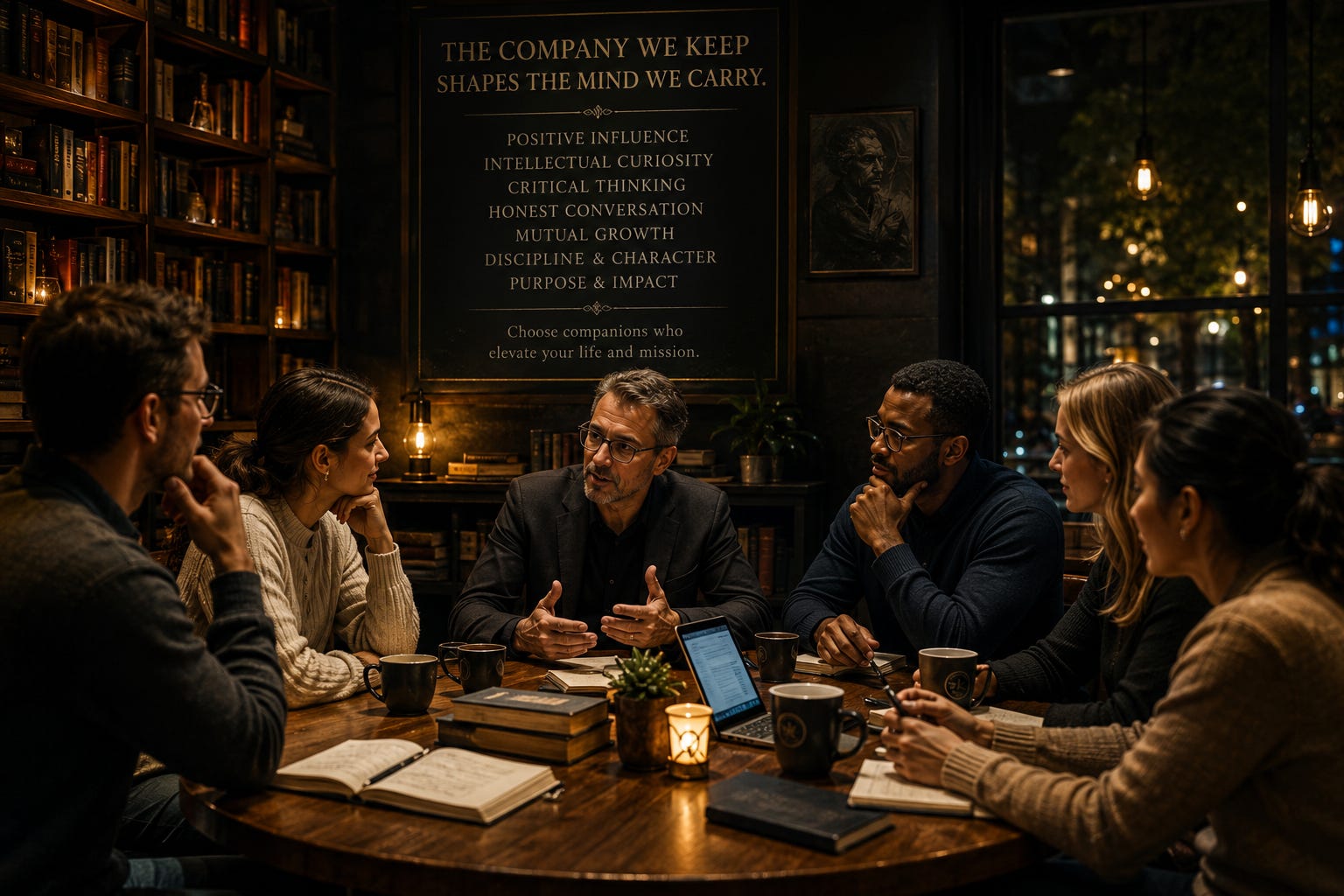
I have learned, both professionally and personally, that the people we surround ourselves with have a profound effect on who we become.
That statement may sound simple, perhaps even obvious. But in my experience as an educator, author, philosopher, and former intelligence analyst, I have come to see it as one of the most important truths in human development. We are not isolated minds moving through the world untouched by others. We are influenced, challenged, strengthened, weakened, sharpened, or dulled by the company we keep.
Human beings are social learners. We absorb language, habits, attitudes, expectations, emotional patterns, and intellectual standards from those around us. Over time, what we repeatedly encounter begins to shape what we consider normal. That is why our social environment matters so much. It does not determine our destiny, but it does condition our thinking, our discipline, our confidence, and even our courage.
I have seen this in classrooms. I have seen it in professional environments. I have seen it in intelligence work, where poor thinking can lead to flawed judgments, and where disciplined thinking can protect lives, institutions, and truth itself. I have also seen it in everyday life, where people either rise because they are surrounded by individuals who challenge and encourage them, or slowly decline because they remain attached to people who normalize complaint, mediocrity, resentment, or intellectual laziness.
The lesson is clear: your circle is not neutral.
The people around you are either helping you become more thoughtful, disciplined, and purposeful, or they are quietly training you to accept less from yourself.
When I speak of surrounding myself with positive people, I do not mean people who deny reality. I have little use for shallow optimism. Positivity, when misunderstood, can become avoidance. It can become a refusal to confront hard truths. That is not strength. That is fragility wearing a smile.
The kind of positive people I value are those who remain constructive in the presence of difficulty. They do not ignore suffering, failure, conflict, or uncertainty. They simply refuse to be ruled by them. They bring perspective. They steady the room. They remind others that difficulty is not the same as defeat.
As a student of Stoicism, I am drawn to people who understand that we do not control everything that happens to us, but we do control how we interpret, respond to, and learn from what happens. That kind of person is invaluable. They do not feed panic. They do not glorify victimhood. They do not confuse emotion with evidence. They help you return to reason.
That matters.
In a world saturated with noise, outrage, distraction, and shallow commentary, a calm and constructive person becomes a form of intellectual shelter.
But positivity alone is not enough. I also believe deeply in surrounding myself with intellectuals.
By intellectuals, I do not simply mean people with degrees, titles, or professional status. I have met highly credentialed people who were intellectually lazy, and I have met people without formal academic recognition who possessed remarkable wisdom. An intellectual, in the best sense, is someone who loves ideas, seeks truth, asks serious questions, reads widely, thinks carefully, and remains humble before complexity.
These are the people who elevate the conversation.
They do not merely ask, “What do you think?” They ask, “Why do you think that?”
They do not merely consume information. They interrogate it.
They do not confuse confidence with correctness.
They are willing to revise their views when better evidence appears.
Being around such people sharpens me. It reminds me that thought is a discipline, not a hobby. It reminds me that learning is not something we finish when we earn a degree. Learning is a lifelong responsibility.
As an educator, I have always believed that the highest purpose of education is not simply to transfer information. It is to form better thinkers. A person can memorize facts and still lack judgment. A person can possess information and still be easily manipulated. A person can be intelligent and still be undisciplined in thought.
That is why critical thinkers matter.
Critical thinkers are not cynics. They are not contrarians who reject everything simply to appear sophisticated. True critical thinkers are intellectually responsible. They examine assumptions. They ask for evidence. They distinguish between fact, inference, opinion, and emotion. They recognize cognitive bias, including their own. They understand that good judgment requires patience, humility, and restraint.
In intelligence analysis, this kind of discipline is not optional. It is essential. Analysts must learn to separate what they know from what they assume. They must resist ideological contamination. They must be alert to confirmation bias, groupthink, mirror imaging, and premature conclusions. They must ask not only, “What does the evidence suggest?” but also, “What might I be missing?”
That same discipline applies to life.
When I surround myself with critical thinkers, I become less vulnerable to sloppy thinking. I become more careful with my words. I become more aware of my assumptions. I become more willing to say, “I do not know,” which is often the beginning of wisdom.
There is a powerful relationship between the people around us and the quality of our metacognition. Metacognition is the ability to think about our own thinking. It is one of the most important skills a person can develop. Yet many people rarely examine how they think. They simply react, defend, assume, and repeat.
The right people interrupt that cycle.
A serious thinker will challenge me when I am being imprecise. A wise friend will tell me when my emotions are outrunning my judgment. A disciplined colleague will ask me to clarify my reasoning. A good mentor will not flatter my ego; they will hold me accountable to my potential.
That is not always comfortable. But comfort is not the highest good.
Growth often begins with being challenged by someone who sees both your capacity and your blind spots.
This is where many people make a mistake. They choose companions based only on ease, familiarity, entertainment, or emotional agreement. They want people who affirm them, not people who refine them. They want applause, not accountability. They want agreement, not truth.
But if everyone around you always agrees with you, you are not in a community. You may be in an echo chamber.
The people we choose should not merely make us feel accepted. They should make us more awake. They should call forth a higher standard of thought, behavior, and character.
I want to be around people who read, question, build, reflect, teach, listen, and take responsibility. I want to be around people who can disagree without becoming hostile. I want to be around people who understand that truth is not discovered through noise, but through disciplined inquiry. I want to be around people who are ambitious without being arrogant, humble without being passive, and critical without being bitter.
That kind of circle changes a person.
It changes what you tolerate. It changes what you pursue. It changes how you speak. It changes how you listen. It changes how you evaluate evidence. It changes how you handle conflict, failure, and uncertainty.
The opposite is also true. If we surround ourselves with people who mock discipline, avoid responsibility, resent excellence, and treat serious thought as unnecessary, we should not be surprised when our own standards begin to erode.
Mediocrity is contagious. So is excellence.
Cynicism is contagious. So is courage.
Intellectual laziness is contagious. So is disciplined inquiry.
This does not mean we abandon compassion for people who are struggling. Nor does it mean we arrogantly separate ourselves from anyone who does not think as we do. That would be a misunderstanding of the point. The issue is not whether we should care about others. We should. The issue is whether we should allow every person equal access to our mind, our time, our attention, and our future.
We should not.
Access to our inner life should be earned by character, wisdom, honesty, and mutual growth.
I have come to believe that choosing one’s circle is an act of self-leadership. It is also an act of moral seriousness. Who we allow to influence us is not a minor decision. It is part of the architecture of our becoming.
The lesson is this: choose companions whose habits you would not be ashamed to imitate.
Choose people who make you more truthful, not merely more comfortable. Choose people who sharpen your thinking, not merely entertain your distractions. Choose people who challenge your assumptions, not merely confirm your biases. Choose people who help you become more disciplined, more courageous, more reflective, and more useful to others.
Because in the end, the company we keep becomes part of the mind we carry.
And if we are serious about becoming better thinkers, better leaders, better educators, better citizens, and better human beings, then we must be serious about the people we allow to shape us.
This resonates deeply
The distinction between shallow optimism and constructive positivity is precise in investigative work, you need people who hold you accountable to the evidence, not to the narrative you've already built
And your point on metacognition may be the most overlooked discipline in my field. The company we keep determines whether we ever question our own methods — and that may be the most dangerous blind spot of all.