Mitigating Decision Making Biases through Metacognitive Intervention
Enhancing Critical Thinking for Analysts, Educators, and Leaders

Abstract
Decision‑making biases—systematic deviations from normative judgment—are among the most persistent obstacles to rigorous critical thinking in intelligence analysis, education, and leadership. Recent research has illuminated not only the prevalence of biases such as confirmation, anchoring, framing, and bias blind spot in professional settings but also the potential of metacognitive interventions to reduce their harmful effects. This paper reviews theoretical foundations of decision‑making bias, the psychology of metacognition, and empirical studies of interventions aimed at bias mitigation. Evidence from clinical decision‑making, crisis decision‑making, field‑setting educational programs, and digital/AI‑assisted environments shows that metacognitive strategies (e.g., self‑monitoring, think‑aloud protocols, provocative prompts) can improve judgment quality, even under time pressure or uncertainty. Practical applications are proposed for analyst tradecraft training, classroom pedagogy, leadership decision meetings, and organizational decision hygiene. Best practices include scaffolding metacognitive awareness, providing feedback, embedding bias education, using digital tools, and ensuring retention through spaced repetition. A case vignette illustrates how an intelligence agency facing conflicting threat reports used metacognitive prompts in forecasting meetings to expose anchoring and confirmation biases, improving decision flexibility. Limitations include variability in effect sizes, difficulty in changing deeply rooted habits, and trade‑offs between speed and deliberation. The paper concludes with recommendations for designing sustainable metacognitive interventions in high‑stakes environments.
Keywords
Decision‑making biases
Metacognition
Bias blind spot
Critical thinking interventions
Confirmation bias
Organizational decision hygiene
Introduction
We all think we’re rational. We all believe we “see the facts,” interpret them fairly, make judgments based on evidence. But cognitive biases are subtler than that. They lurk in assumptions, in what we choose first, in how we evaluate evidence under pressure. For analysts, educators, and leaders, these biases are not nuisances—they are failure vectors. If you don’t detect them, they lead to mis‑forecasts, mis‑teaching, mis‑policy.
Metacognition—thinking about thinking—has emerged as a promising lever to expose, reduce, and manage our biases. But it’s not a magic bullet. Effectiveness depends on how interventions are structured, which biases are targeted, the domain, and the stakes. This paper maps what we know about decision‑making biases, reviews metacognitive intervention research, and lays out how to apply this knowledge in intelligence, education, and leadership contexts.
Background & Theory
Decision‑Making Biases: What They Are & Why They Matter
Decision‑making biases refer to systematic patterns of deviation from rational judgment or normative standards (heuristics and biases tradition; Kahneman & Tversky). Well‑documented biases include confirmation bias, anchoring, availability, framing, overconfidence, premature closure, bias blind spot, among others. In professional and high‑stakes environments, these biases impair judgment. For example, in clinical decision‑making (especially under stress/time pressure), numerous biases lead to diagnostic error and patient harm. (BioMed Central)
Crisis decision‑making, intelligence assessment, organizational strategy — all suffer when biases are unmitigated. A 2022 study showed that even crisis experts remain vulnerable to anchoring, framing effects, and bias blind spot. (ScienceDirect) So learning to identify and counteract these biases is essential.
Metacognition: Theory and Mechanisms
Metacognition is broadly “thinking about one’s own thinking”—awareness of cognitive processes (declarative), strategies for managing them (procedural), and knowing when to apply which strategy (conditional). It includes self‐monitoring, reflection, error detection, planning, and regulation of one's reasoning process.
The theory is that metacognitive awareness can act as a “circuit breaker” when biases are likely to operate unconsciously. For instance, being aware of anchoring or confirmation bias gives a person the chance to pause, consider alternate hypotheses, seek disconfirming evidence, or otherwise intervene in the decision process.
Empirical Findings on Interventions
Training & Education: Programs that include explicit teaching about biases, combined with reflective practice and feedback, show positive effects. For example, a recent study of graduate business students showed that structured bias‑reduction training improved decision outcomes in field settings—even in the absence of reminders of bias. (Insights@Questrom)
Metacognitive Strategies: The ARDESOS‑DIAPROVE program in higher education integrated metacognitive instruction with Problem‑Based Learning. It improved students’ critical thinking and metacognitive regulation. (Frontiers)
Digital Tools and Prompts: In AI or generative search contexts, metacognitive prompts that require users to reflect, assess reliability, and consider alternate perspectives help reduce acceptance of poor evidence and surface overlooked evidence. (arXiv)
Retention & Gaming: Interactive or gamified debiasing interventions have better retention over time than passive methods (video or lecture). E.g., the study on games vs videos found that games reduced confirmation bias, bias blind spot, and other biases, with effects lasting over weeks. (Frontiers)
Bias Blind Spot Research: Studies show that many individuals underestimate their own susceptibility to bias (the bias blind spot), which blocks efforts at self‑correction. Instrumentation (scales) exist for measuring this trait, and understanding this blind spot is essential for designing interventions. (INFORMS Pubs Online)
Practical Application
Here’s how analysts, educators, and leaders can use these findings in real settings:
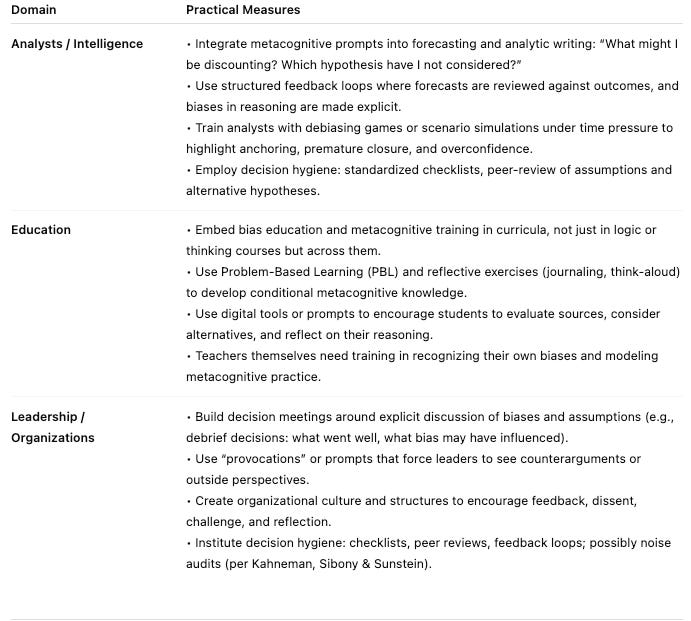
Methods or Best Practices for Intervention Design
From the empirical literature, here are best practices for designing metacognitive interventions to mitigate decision‑making bias:
Explicit Bias Education: Teach what various biases are, how they operate, what their triggers are. Without explicit awareness, people often cannot self‑detect bias.
Metacognitive Prompting: Design prompts that encourage reflection, pause, consideration of alternatives, noting assumptions, asking “What would I need to be wrong?”
Active Practice & Feedback: Simulations, case studies, role‑play, or gamified environments where participants make judgments, receive feedback about which biases affected them, and can revise.
Spaced and Repeated Interventions: Single interventions have some effect, but repetition over time, spaced practice, and repeated exposure strengthen retention. (Frontiers)
Contextualization / Realistic Scenarios: Interventions are more effective when the tasks approximate real work demands: time pressure, partial information, ambiguity.
Measuring Both Immediate and Longitudinal Effects: Assess right after intervention, but also after some delay to see whether gains persist; also measure transfer to new domains.
Addressing Bias Blind Spot: Include components to help people recognize their own susceptibility; use tools to make self‑assessment and peer assessment of bias more feasible.
Organization/Structural Support: Without leadership buy‑in, feedback mechanisms, and decision hygiene, individuals will revert to default biased behavior.
Case Vignette
Scenario: An intelligence agency is assessing possible destabilizing influence in a neighboring country. Multiple sources: social media chatter, diplomatic cables, economic data. Conflicting reports: some claim coordinated interference from a state actor; others argue disinformation, rumor, or exaggeration.
Initial Conditions: Analysts meet in their usual forecasting meeting. The lead analyst quickly anchors on the hypothesis of state actor intervention, citing a high‑visibility social media campaign. Other evidence is weaker or reports from less trusted sources. Time pressure due to an impending briefing to policymakers.
Metacognitive Intervention: A mid‑meeting prompt is introduced: before finalizing the analysis, each participant must list at least two alternative hypotheses, note their key assumptions, identify what disconfirming evidence would look like, and rate their confidence. A facilitator encourages reflection and asks whether the anchoring on the social media campaign is warranted given evidence weight.
Effects: The group identifies that some reports might be misattributed (rumor, bots), that economic data could be misleading due to lag, and that diplomats may be over‑interpreting ambiguous behavior. Confidence in the state‑actor hypothesis is revised downward; recommendations to gather more corroborating intelligence, to monitor disinformation channels, and to prepare alternative scenarios are included in the product. The briefing airs with more nuance; policymakers are better informed of risk and uncertainty.
Outcome: Subsequent intelligence confirms that some campaign was organic rather than state‑sponsored, reducing risk of overreaction. The agency incorporates metacognitive prompts as standard in forecasting templates; analysts report improved awareness of cognitive traps.
Recommendations
Based on theory, evidence, and the case, here is what should be done to operationalize metacognitive interventions for bias mitigation:
Institutionalize Metacognitive Prompts in Deliverables: Forecasting templates, reports, policy briefs should include structured sections requiring identification of assumptions, alternatives, and potential monitoring triggers for disconfirmation.
Design Debiasing Training Programs: Use interactive, gamified interventions rather than lectures alone; include realistic scenarios, feedback, repetition, and variance of domain.
Train Leadership: Leaders set tone. If senior leadership model awareness of bias, request alternative hypotheses, encourage dissent and critical reflection, it trickles down.
Measure and Audit Decision Quality: Adopt metrics — frequency of bias errors, variance among judgments (“noise”), instances of overconfidence, successful predictions vs failures, feedback loops. Use audits to find where bias is implicated.
Support Reflection Culture: Post‑action reviews (after decisions/events), debriefings that explicitly explore cognitive pitfalls, what assumptions were hidden, what bias may have misled.
Use Digital Tools & AI as Support, Not Replacement: AI tools or digital prompts (e.g., pop‑ups, search tools) can be designed to bring metacognitive interruptions — but they must be balanced so they don’t become rote or cause decision fatigue.
Limitations
It would be dishonest to pretend metacognitive interventions solve everything. Several limitations must be acknowledged:
Effect Size & Variability: Many studies show small to moderate effect sizes. Some biases are harder to mitigate than others. Context matters: under time pressure, stress, or strong incentives, bias mitigation often weakens.
Transfer and Retention: Even when improvements are shown right after training, many studies show fade‑out over time or weak transfer to novel domains.
Practical Constraints: In intelligence/leadership, time, urgency, resource constraints make deep reflection expensive. Bias education or metacognitive practices may be seen as slowing things down.
Resistance and Cultural Barriers: Admitting bias is admitting fallibility. Institutions that reward certainty or penalize dissent will suppress metacognitive reflection. Bias blind spot means people often believe they are less biased than others, reducing motivation to change.
Trade‑off Between Speed and Deliberation: Some decisions must be made fast; insisting on metacognitive checks can delay action. The art is knowing when to apply them.
Conclusion
Listen: biases are baked into human cognition. There’s no getting rid of them completely. But bias does not have to be your default. If you’re serious about critical thinking, you need strategies—not just ideals. Metacognition is one of the strongest tools we have. Train for it, embed it in your processes, use feedback, insist on reckoning with assumptions.
For analysts, educators, and leaders: the goal isn’t perfect rationality—it’s better decision‑making. More flexible judgment. Clearer awareness of what you don’t know. If you discipline yourself to pause, question, reflect, even under pressure, your decisions will be measurably more accurate, more justifiable, more resilient.
References
Awanzo, A., et al. (2025). Cognitive biases in clinical decision‑making in prehospital critical care: A scoping review. Scandinavian Journal of Trauma, Resuscitation and Emergency Medicine, 33(1), 37. https://doi.org/10.1186/s13049‑025‑01415‑1
Batdı, V. (2024). Evaluation of the effectiveness of critical thinking training on critical thinking skills and academic outcomes. Review of Educational Research. Advance online publication. https://doi.org/10.1002/rev3.70001 (Bera Journals)
Dawson, C., et al. (2024). Evidence‑based scientific thinking and decision‑making in “naturalistic” scientific issues: Individual differences in thinking styles, attitudes, prosociality, and emotional factors. Cognitive Research: Principles and Implications, 9(1), 47. https://doi.org/10.1186/s41235‑024‑00578‑2
Denckla, C. A., et al. (2020). Psychological resilience: An update on definitions, a critical review. European Psychologist, 25(1), 1‑18. https://doi.org/10.1027/1016‑9040/a0003885
Gómez, D. L. J., et al. (2025). Determining factors for the development of critical thinking. Frontiers in Psychology, 16, Article 115432. https://doi.org/10.3389/fpsyg.2025.115432
Korteling, J. E., et al. (2023). Cognitive bias and how to improve sustainable decision‑making. Humanities and Social Sciences Communications, 10, 400. https://doi.org/10.1057/s41599‑023‑01606‑3
Kosior, K., et al. (2019). The role of metacognition in teaching clinical reasoning. Advances in Health Professions Education, 6(2), 105‑116. https://doi.org/10.1007/s10459‑019‑09865‑x
Li, S., et al. (2024). Metacognition predicts critical thinking ability beyond working memory. Thinking Skills and Creativity, 58, 101027. https://doi.org/10.1016/j.tsc.2024.101027
Paulus, D., et al. (2022). The influence of cognitive bias on crisis decision‑making. International Journal of Disaster Risk Reduction, 72, Article 102779. https://doi.org/10.1016/j.ijdrr.2022.102779
Pereles, A., et al. (2024). The power of metacognitive strategies to enhance critical thinking in self‑regulated learning contexts. Journal of Technology and Science Education, 14(2), 2721. https://doi.org/10.3926/jotse.2721
Scopelliti, I., et al. (2015). Bias blind spot: Structure, measurement, and consequences. Management Science, 61(11), 2656‑2675. https://doi.org/10.1287/mnsc.2014.2096
Wang, F. F., et al. (2024). Metacognitive processes, situational factors, and clinical reasoning: A longitudinal study in nursing education. BMC Medical Education, 24, Article 367. https://doi.org/10.1186/s12909‑024‑06467‑y
Author Bio
Dr. Charles M. Russo is a veteran intelligence professional, educator, and author with over three decades of experience across U.S. military intelligence and the U.S. Intelligence Community, including analytic roles supporting national security missions. He teaches and writes on analytic tradecraft, critical thinking, and the ethical obligations of intelligence work, with a focus on strengthening judgment under uncertainty and resisting politicization and deception.
Disclaimer
This article is for educational and professional-development purposes. It reflects the author’s analysis and interpretation of publicly available sources and does not represent official positions of any U.S. government agency, department, or element. No classified information is used or referenced.