
Idiocracy by Consent:
Mediocrity, Politics, and the Collapse of Serious Education

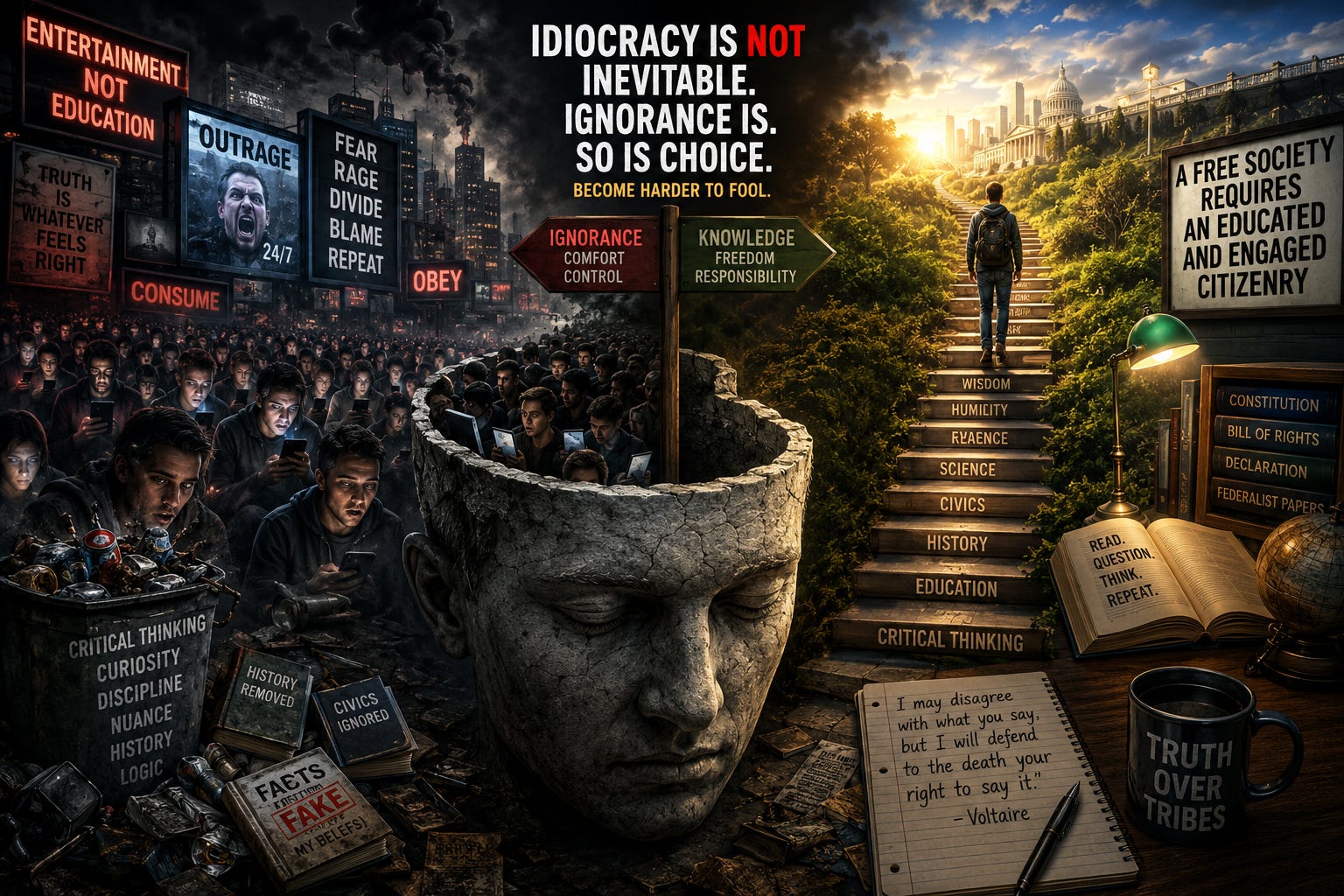
Abstract
Modern society is not suffering from a shortage of information. It is suffering from a shortage of disciplined thinking. Despite unprecedented access to knowledge, many citizens remain vulnerable to misinformation, political manipulation, civic ignorance, shallow media consumption, and institutional mediocrity. This article argues that the rise of “idiocracy” is not primarily a question of intelligence, but of culture: a culture increasingly comfortable with intellectual laziness, grade inflation, performative politics, anti-intellectualism, and emotional reaction over evidence-based reasoning. Drawing on research from education, civic literacy, media studies, psychology, and democratic governance, this article examines how weak education, degraded political discourse, and poor critical thinking are eroding public life. It concludes with recommendations for rebuilding intellectual seriousness, civic responsibility, and educational standards.
Introduction: The Age of Comfortable Ignorance
Let’s stop pretending this is mysterious.
Our world is not filled with idiocracy because knowledge is unavailable. It is not because books disappeared. It is not because data vanished. It is not because people lack access to history, science, philosophy, civics, economics, or public records. We live in an age where a person can access more information in ten minutes than many previous generations could access in a lifetime.
And still, ignorance is thriving.
That should disturb us.
The problem is not access. The problem is appetite. The problem is discipline. The problem is intellectual character. Too many people want the confidence of experts, the moral authority of activists, the voting power of citizens, and the social influence of commentators without doing the work required to think seriously.
They want opinions without study.
They want outrage without evidence.
They want political certainty without civic knowledge.
They want freedom without responsibility.
They want credentials without competence.
They want to be taken seriously while refusing to become serious people.
By “idiocracy,” I do not mean low intelligence. Intelligence is complicated, uneven, and shaped by opportunity, environment, education, motivation, and experience. The greater danger is not that people lack raw intelligence. The greater danger is that many people have become comfortable being aggressively uninformed.
Idiocracy, in this sense, is a cultural condition. It is a society where ignorance becomes normal, shallow thinking becomes entertainment, outrage replaces reasoning, credentials replace competence, and mediocrity gets protected because truth makes people uncomfortable.
Mediocrity becomes dangerous when people stop being embarrassed by not knowing. It becomes catastrophic when they become proud of it.
A serious civilization cannot survive that way.
The Evidence: Education Is Weakening While Confidence Remains High
The evidence is not flattering.
Across countries in the Organisation for Economic Co-operation and Development, the 2022 Programme for International Student Assessment showed a record decline in mathematics performance between 2018 and 2022. Reading performance also declined sharply, and the OECD noted that reading and science trends had already been weakening over approximately the previous decade (OECD, 2023). This was not just a pandemic problem. The pandemic worsened the damage, but it did not create the underlying rot.
In the United States, the National Assessment of Educational Progress has shown troubling declines in reading achievement. The 2024 results indicated that reading scores for fourth graders were lower than in both 2022 and 2019, and the National Assessment Governing Board reported that reading scores declined nationally for both fourth and eighth graders, with no state showing reading gains compared with 2022 (National Assessment Governing Board [NAGB], 2025; National Center for Education Statistics [NCES], 2024).
That is not a small problem. Reading is not merely one school subject among many. Reading is the foundation of independent thought. A person who cannot read carefully cannot reason deeply. A person who cannot reason deeply cannot evaluate complex claims. A person who cannot evaluate complex claims becomes vulnerable to manipulation.
The adult data are just as troubling. In the 2023 Survey of Adult Skills, U.S. adults ages 16 to 65 showed serious weaknesses in literacy, numeracy, and adaptive problem solving. According to NCES, 28% of U.S. adults scored at Level 1 or below in literacy, 34% scored at Level 1 or below in numeracy, and 32% scored at Level 1 or below in adaptive problem solving. Only 44% reached Level 3 or above in literacy, 38% in numeracy, and 32% in adaptive problem solving (NCES, 2024). The OECD also reported that the United States scored below the OECD average in numeracy and adaptive problem solving (OECD, 2024).
In plain language: many adults are not equipped to interpret data, evaluate evidence, or solve complex problems in a world that increasingly requires all three.
And yet we keep pretending that diplomas automatically equal education.
They do not.
A diploma may indicate attendance, compliance, or institutional completion. It does not automatically indicate literacy, judgment, discipline, curiosity, or intellectual maturity. That distinction matters. A society that confuses credentials with competence eventually produces leadership without wisdom, graduates without readiness, and voters without civic understanding.
ACT’s 2024 national profile reported that only 20% of tested students met all four ACT College Readiness Benchmarks (ACT, 2024). ACT defines those benchmarks as scores associated with at least a 50% chance of earning a B or higher and approximately a 75% to 80% chance of earning a C or higher in corresponding college courses (ACT, n.d.). Meanwhile, ACT research has found evidence of high school GPA inflation from 2018 to 2022 despite stable or slightly declining ACT scores, warning that grades alone may misrepresent college readiness (Sanchez, 2024).
That is institutional dishonesty.
Passing students forward when they are not ready is not compassion. It is abandonment dressed up as kindness. It tells young people they are prepared when they are not. It protects adult comfort at the expense of student development. It makes schools look better on paper while students struggle in reality.
That is not education.
That is credential management.
Civic Ignorance: The Republic Cannot Run on Vibes
Civic ignorance is especially dangerous because it does not stay private. It votes. It joins juries. It spreads online. It becomes policy pressure. It elects people. It excuses corruption. It turns complex constitutional questions into slogans shouted by people who cannot explain the system they are shouting about.
In 2022, only 22% of eighth graders performed at or above NAEP Proficient in civics, and about one-third scored below NAEP Basic (National Assessment of Educational Progress [NAEP], 2022). The National Assessment Governing Board noted that many students below Proficient likely struggle with concepts such as separation of powers and checks and balances (NAGB, 2023).
That is a civic emergency.
A republic cannot function when citizens do not understand how power is structured, limited, abused, and checked. A person who does not understand separation of powers is easier to manipulate by anyone promising simple answers. A person who does not understand due process is easier to seduce by mob justice. A person who does not understand constitutional rights is easier to trick into giving them away.
The problem is not limited to students. In 2024, the Annenberg Public Policy Center found that only 65% of Americans could name all three branches of government, while 15% could name none. Less than half could name most First Amendment rights (Annenberg Public Policy Center, 2024).
That is embarrassing. More importantly, it is dangerous.
People love to say, “We the people.” Fine. But “we the people” must know something. A constitutional republic does not run on vibes, memes, tribal loyalty, and emotional spasms. It requires citizens who can think beyond party identity, understand institutions, detect demagoguery, and distinguish law from preference.
If citizens do not know how government works, they will become servants of those who do.
The Internet Did Not Make People Stupid; It Exposed the Problem
The internet did not create intellectual laziness. It industrialized it.
The modern information environment rewards speed, emotion, outrage, and performance. It does not reward patience, humility, or careful verification. People claim they are “doing their own research” when, in reality, many are consuming algorithmically selected content designed to provoke them, flatter them, or trap them in a feedback loop.
Real research is slow. It requires source evaluation, comparison, context, doubt, and revision. Watching three videos that confirm what one already believes is not research. Sharing a screenshot without reading the original source is not research. Repeating a podcaster’s opinion with confidence is not research.
It is intellectual outsourcing.
Stanford researchers studying civic online reasoning found that high school students struggled significantly when evaluating online information. In one national study, when students were asked to assess a website claiming to provide factual climate science reports, 96% failed to discover the organization’s ties to the fossil fuel industry (Breakstone et al., 2021).
That is not a minor educational weakness. That is a vulnerability.
If people cannot determine who is behind a claim, what incentives are involved, what evidence supports it, and what context is missing, then they are not independent thinkers. They are targets.
The problem is made worse by declining reading habits. The National Endowment for the Arts reported that in 2022 fewer than half of U.S. adults had read a book in the previous 12 months, and only 38% reported reading fiction or short stories, reflecting declines over the previous decade (National Endowment for the Arts, n.d.).
This matters because deep reading builds deep attention. It trains the mind to follow arguments, hold complexity, interpret language, and delay judgment. A society that stops reading becomes easier to manipulate because it loses patience for nuance.
And nuance is exactly what demagogues, propagandists, and ideological grifters want to destroy.
Politics Has Become a Factory for Intellectual Decay
Modern politics has adapted perfectly to public weakness.
It no longer needs to persuade serious citizens with sustained arguments. It can trigger identity, resentment, fear, grievance, and moral outrage. It can turn every issue into a loyalty test. It can replace policy with performance and governance with theater.
Many people do not engage politics to learn. They engage politics to belong.
That is the danger.
Research on political identity has shown that partisan attachment can shape how people process information, often causing them to prioritize group loyalty over accuracy (Van Bavel & Pereira, 2018). This means political belief is not always about facts. Sometimes it is about identity protection. Sometimes people defend bad arguments not because the arguments are strong, but because the arguments belong to their tribe.
This is how political stupidity survives. Not because the evidence is unclear, but because admitting the evidence would threaten belonging.
Misinformation thrives in this environment. Research by McLoughlin and colleagues (2024) found that outrage-evoking misinformation spreads powerfully online and that people may share such content as a way of signaling moral or group identity rather than because they have verified its truth.
That is the disease.
People are not merely misinformed. Many are emotionally rewarded for staying misinformed.
They get attention for outrage. They get belonging from tribal loyalty. They get status from certainty. They get applause for mocking complexity. They get dopamine from being angry.
And politics feeds on it.
Politicians lie because voters reward lies that flatter them. Political influencers simplify because audiences reward simplification. Parties manipulate because citizens allow themselves to be manipulated as long as the manipulation attacks the other side.
This is where people need to be called out directly: citizens cannot keep blaming corrupt politics while consuming politics like professional wrestling.
You cannot complain about propaganda while sharing posts you never checked.
You cannot scream about corruption while excusing it from your own side.
You cannot demand freedom while refusing to learn how your government works.
You cannot pretend to be informed when your worldview is built from clips, memes, headlines, and rage.
That is not citizenship.
That is emotional spectatorship.
Media Fragmentation and the Collapse of Shared Reality
The media environment has become a battlefield of attention.
Traditional news institutions have lost public trust and audience engagement, while digital platforms, influencers, podcasters, YouTubers, TikTok creators, and partisan commentators increasingly shape public understanding. The Reuters Institute’s 2025 Digital News Report described a fragmented news environment marked by declining engagement with traditional news, low trust, and growing influence from social media and video platforms (Reuters Institute for the Study of Journalism, 2025).
Pew Research Center reported that one-fifth of U.S. adults regularly get news from TikTok, up sharply from 2020, and that 43% of adults under 30 regularly get news from TikTok (Pew Research Center, 2025b).
This does not mean every independent commentator is bad. It does not mean every traditional news outlet is virtuous. That would be lazy thinking too. Many legacy institutions have damaged their own credibility through bias, arrogance, sensationalism, and selective coverage. Many independent voices have contributed valuable criticism and analysis.
But the larger problem remains: the gatekeeping system weakened before the public developed enough intellectual discipline to replace it responsibly.
So now millions of people are building their understanding of the world through emotionally charged fragments. They consume short clips without context. They mistake commentary for reporting. They trust personalities over evidence. They confuse virality with credibility.
The algorithm is not designed to make people wise.
It is designed to keep people engaged.
Those are not the same thing.
The Dunning-Kruger Civilization
One of the most dangerous features of intellectual incompetence is that people often do not know how much they do not know.
Kruger and Dunning’s classic research found that individuals with low competence in a domain often overestimate their ability because they lack the very skills needed to recognize their own deficiencies (Kruger & Dunning, 1999). This matters far beyond psychology experiments. It describes much of modern public discourse.
People who have never studied constitutional law speak with total certainty about constitutional questions.
People who cannot interpret a basic chart lecture others about economics.
People who do not understand scientific method talk as if they have overturned entire fields.
People who have never read serious history weaponize historical analogies.
People who cannot define socialism, fascism, liberalism, conservatism, or democracy use those words as insults.
This is not merely ignorance.
It is ignorance plus arrogance.
That combination is lethal.
A humble ignorant person can learn. An arrogant ignorant person becomes dangerous because they mistake correction for attack and knowledge for oppression.
That is where we are culturally. Too many people do not want to be educated. They want to be validated. They want their assumptions confirmed, their tribe praised, their enemies humiliated, and their feelings treated as evidence.
But feelings are not evidence.
Confidence is not competence.
Volume is not truth.
And being offended is not the same thing as being right.
Mediocrity Has Become Protected
Mediocrity survives because it is comfortable.
Excellence is demanding. Serious education is demanding. Clear writing is demanding. Mathematical competence is demanding. Historical knowledge is demanding. Civic responsibility is demanding. Intellectual humility is demanding.
Mediocrity asks for none of that.
Mediocrity lets people blame systems without examining their own habits. It lets institutions lower standards and call it equity. It lets adults avoid reading and call themselves informed. It lets students resist rigor and call it stress. It lets politicians avoid substance and call it messaging. It lets citizens confuse cynicism with wisdom.
This is not a call for cruelty. Standards are not cruelty. Correction is not cruelty. Rigor is not cruelty. Challenge is not cruelty.
In fact, the absence of standards is often the deeper cruelty.
When schools lower expectations, students lose. When parents excuse laziness, children lose. When colleges prioritize comfort over intellectual formation, students lose. When public discourse rewards shallow confidence over disciplined thought, democracy loses.
A society that protects mediocrity eventually becomes mediocre by design.
Democracy Cannot Survive Intellectual Laziness
The political consequences are already visible.
Pew Research Center reported that public trust in the federal government remained near historic lows in 2025, with only 17% of Americans saying they trusted Washington to do what is right just about always or most of the time (Pew Research Center, 2025a). Low trust does not automatically prove citizens are wrong to be skeptical. Government has earned plenty of skepticism. Institutions have failed in serious ways.
But distrust without knowledge becomes paranoia.
Skepticism without discipline becomes conspiracy thinking.
Anger without civic understanding becomes manipulation.
Globally, democratic systems are under pressure. International IDEA reported that democratic declines continue to outnumber advances in many areas of the world (International IDEA, 2024). Freedom House reported continued global declines in freedom, and V-Dem has documented ongoing patterns of autocratization, including media censorship and attacks on democratic institutions (Freedom House, 2026; V-Dem Institute, 2026).
Ignorant citizens do not cause every democratic crisis. That would be too simplistic. But they make every democratic crisis easier to exploit.
Autocrats love ignorant citizens.
Demagogues love angry citizens.
Propagandists love distracted citizens.
Corrupt leaders love cynical citizens who believe everyone is corrupt anyway.
A serious democracy requires more than voting. Voting is necessary, but it is not sufficient. Democracy requires judgment. It requires memory. It requires civic knowledge. It requires self-restraint. It requires citizens capable of saying, “My side is wrong on this.” Without that, democracy becomes a tribal combat arena where the only goal is victory.
And when victory matters more than truth, liberty is already in danger.
Recommendations: How to Fight the Idiocracy
The crisis of idiocracy and mediocrity will not be solved by slogans, hashtags, political theater, or another empty “awareness campaign.” Awareness without discipline is useless. People already know the culture is sick. The question is whether they are willing to do anything about it.
The following recommendations are not soft suggestions. They are civic necessities.
Restore Academic Seriousness in Schools
Schools must return to the fundamentals: reading, writing, mathematics, science, history, civics, logic, rhetoric, and research literacy. These are not optional “old-school” subjects. They are the architecture of a functioning mind.
Grade inflation must be confronted directly. Passing students who cannot read, write, calculate, analyze, or explain basic civic ideas is not compassion. It is malpractice.
Students need to be taught how to write arguments, not just opinions. They need to read primary sources, not just slides. They need to study constitutional principles, not just political talking points. They need to learn statistics so they can recognize manipulation. They need to understand history so they do not become easy prey for propaganda.
Education should make students harder to fool.
If it does not, it has failed.
Make Critical Thinking a Core Requirement
Everyone claims to value critical thinking. Most people do not practice it.
Critical thinking is not “question everything” in the lazy internet sense. It is not reflexive distrust. It is disciplined judgment.
Critical thinking requires asking: What is the evidence? What is the source? What are the assumptions? What is being left out? What would disprove this claim? Am I reacting emotionally because the claim is false, or because it threatens my identity?
Schools, colleges, workplaces, and civic institutions should explicitly teach logic, cognitive bias, fallacies, source evaluation, probability, argument mapping, and ethical reasoning. These skills should be assessed repeatedly. They should not be trapped in one freshman seminar or one “media literacy” lesson.
A society that cannot distinguish evidence from emotion will eventually be ruled by whoever manipulates emotion best.
Rebuild Civic Education
A republic cannot survive when citizens do not understand how government works.
Every student should graduate knowing the Constitution, separation of powers, federalism, civil liberties, due process, the role of courts, the function of local government, and the responsibilities of citizenship. Adults should be expected to learn these things too.
There is no excuse for having loud political opinions while being unable to explain the basic structure of the government one is criticizing.
Civic education must also include civic virtue: humility, restraint, responsibility, courage, fairness, and respect for truth. Rights without responsibility produce entitlement. Freedom without knowledge produces chaos.
Hold Adults Accountable for Intellectual Laziness
This may be the most uncomfortable recommendation: adults need to stop making excuses for not learning.
Being busy is real. Responsibilities are real. But millions of people find time for endless scrolling, political outrage, celebrity gossip, sports drama, streaming, and algorithmic junk. So the issue is not always lack of time. Often, it is lack of priority.
Adults should build a serious learning routine. Read books. Study history. Read opposing viewpoints. Learn basic economics. Learn how science works. Learn how statistics can be abused. Learn the difference between journalism, commentary, propaganda, and entertainment.
The modern adult cannot afford to be intellectually passive.
Passive citizens become managed citizens. They do not shape society. They are shaped by it.
Stop Rewarding Performative Intelligence
One of the great diseases of the age is the performance of knowledge.
People speak with certainty because certainty gets attention. Nuance gets ignored. Doubt looks weak. Rage looks powerful. Confidence is mistaken for competence.
We must stop rewarding people simply because they sound bold, clever, sarcastic, or ideologically satisfying. The question should not be, “Did this person confirm my beliefs?” The question should be, “Does this person know what they are talking about?”
Public intellectual life should reward clarity, evidence, intellectual humility, and courage. It should punish dishonesty, manipulation, bad-faith argument, and lazy certainty.
The loudest voice in the room is often not the wisest.
Sometimes it is just the least self-aware.
Treat Media Consumption Like an Intellectual Diet
People understand that eating garbage every day damages the body. They refuse to apply the same logic to the mind.
A person who consumes rage-driven media all day should not be surprised when they become paranoid, tribal, anxious, and intellectually sloppy. A person who gets most of their worldview from memes, influencers, short clips, and partisan commentary should not pretend to be deeply informed.
Citizens need a better media diet. Read long-form journalism. Read books. Read primary documents. Compare sources. Check original data. Follow serious scholars, not just charismatic personalities. Slow down before sharing. Stop confusing virality with truth.
The algorithm is not your teacher.
It is your handler unless you learn to resist it.
Demand Better From Political Leaders
Politicians lie because they are rewarded for lying.
They oversimplify because citizens reward oversimplification. They perform outrage because outrage mobilizes attention, money, and votes. They avoid substance because many citizens do not demand substance.
Citizens must stop acting shocked when politicians behave badly while continuing to support the same behavior from their own side. There is no moral courage in condemning dishonesty only when the other party does it.
Demand evidence. Demand specifics. Demand serious debate. Demand policy literacy. Punish leaders who exploit ignorance, fear, resentment, and tribal loyalty. Refuse to defend stupidity because it wears your preferred political colors.
If citizens want better politics, they must become harder to manipulate.
Parents Must Become Educational Partners
Parents cannot outsource all intellectual development to schools and then complain when the results are poor.
Education begins at home. Reading begins at home. Curiosity begins at home. Discipline begins at home.
Children should see adults reading. They should hear serious conversations. They should be taught to ask better questions. They should be expected to explain their reasoning. They should be corrected when they confuse opinion with fact.
Parents must also resist the temptation to protect children from every intellectual struggle. Difficulty is not abuse. Challenge is not oppression. Discomfort is often the beginning of growth.
A child who never learns discipline becomes an adult who mistakes effort for trauma.
Colleges Must Recover Their Mission
Higher education cannot merely sell credentials. It must cultivate judgment.
Colleges should not be ideological daycare centers, luxury brands, or bureaucratic credential factories. They should be places where students encounter difficult ideas, serious scholarship, rigorous disagreement, and intellectual standards.
Students should be expected to read deeply, write clearly, defend claims, revise arguments, and engage opposing viewpoints without collapsing emotionally or retreating into slogans.
The purpose of higher education is not to make students comfortable.
It is to make them capable.
Build a Culture That Respects Excellence Again
Mediocrity thrives when excellence is mocked, diluted, or treated as elitist.
But excellence is not elitism. Excellence is responsibility.
A serious society honors craftsmanship, scholarship, competence, discipline, courage, and wisdom. It does not lower every standard to protect every feeling. It does not confuse access with achievement. It does not call everyone excellent just to avoid telling the truth.
People do not rise when standards disappear.
They drift.
The goal is not cruelty. The goal is honesty. People deserve compassion, but they also deserve truth: a civilization cannot survive on laziness, excuses, and shallow thinking.
Conclusion: Become Harder to Fool
Our world is not drifting into idiocracy because people are incapable of thinking. It is drifting because too many people have stopped valuing thought.
They have traded wisdom for entertainment, education for credentials, citizenship for tribal loyalty, and truth for emotional convenience.
That is the real danger.
Not that people do not know everything. No one does. The danger is that too many people do not care that they do not know. Worse, many have become proud of not knowing. They call ignorance authenticity. They call expertise arrogance. They call discipline oppression. They call standards unfair. They call disagreement violence. They call emotional reaction “truth.”
This is how a society weakens from within.
Politics did not create all of this, but politics has exploited it ruthlessly. A poorly educated, emotionally reactive, historically ignorant public is easy to divide and easier to control. Citizens who do not read are easier to manipulate. Citizens who do not understand institutions are easier to deceive. Citizens who cannot evaluate evidence are easier to radicalize. Citizens who think in slogans are easier to govern badly.
The way forward is not despair.
Despair is just another form of surrender.
The way forward is intellectual discipline. Read. Study. Question. Verify. Think. Debate honestly. Admit error. Raise standards. Teach children to reason. Demand evidence from leaders. Refuse to be entertained into stupidity.
A civilization is not saved by comfortable people making excuses.
It is saved by serious people doing serious work.
The uncomfortable truth is that idiocracy is not merely something happening to us. It is something we tolerate. Every time we excuse ignorance, reward dishonesty, lower standards, mock expertise, or choose tribal comfort over truth, we participate in the decline.
The remedy begins with a simple but brutal demand:
Become harder to fool.
That is not just an educational goal.
It is a moral obligation.
Author Bio
Dr. Russo is a keynote speaker, educator, author, philosopher, and intelligence analyst whose work explores critical thinking, metacognition, education, intelligence analysis, national security, homeland security, criminal justice, terrorism, and the philosophical foundations of responsible citizenship.
His scholarship and public commentary focus on helping individuals and institutions think more clearly, reason more carefully, and confront intellectual complacency with discipline and courage. Drawing from the traditions of Stoic philosophy, intelligence tradecraft, civic education, and ethical leadership, Dr. Russo challenges audiences to reject passive thinking, examine assumptions, and develop the habits necessary for serious judgment in a chaotic information environment.
His work is grounded in a central conviction: freedom requires wisdom, citizenship requires responsibility, and a society that abandons critical thinking eventually abandons itself.
Disclaimer
This article is intended for educational, scholarly, and commentary purposes. It offers a critical perspective on education, politics, media culture, civic responsibility, and public reasoning. The use of strong language and direct criticism is rhetorical and analytical, not personal or discriminatory.
The term “idiocracy” is used as a cultural critique of anti-intellectualism, civic ignorance, shallow media consumption, and normalized mediocrity. It is not intended as a clinical, psychological, or medical label.
The views expressed are those of the author and should not be interpreted as representing any institution, employer, government agency, political party, or professional organization unless explicitly stated. The article does not provide legal, medical, psychological, or official political advice.
Readers are encouraged to examine the evidence, consult original sources, challenge the argument where appropriate, and engage the subject with intellectual honesty. The central purpose of this work is not to insult, but to provoke reflection, accountability, and a renewed commitment to serious education, civic responsibility, and disciplined thought.
References
ACT. (n.d.). ACT college readiness benchmarks. https://www.act.org/content/act/en/college-and-career-readiness/benchmarks.html
ACT. (2024). ACT profile report: National graduating class 2024. ACT Education Corp. https://www.act.org/content/dam/act/unsecured/documents/2024-act-national-graduating-class-profile-report.pdf
Annenberg Public Policy Center. (2024, September 12). A majority of Americans can’t recall most First Amendment rights. University of Pennsylvania. https://www.annenbergpublicpolicycenter.org/most-americans-cant-recall-most-first-amendment-rights/
Breakstone, J., Smith, M., Wineburg, S., Rapaport, A., Carle, J., Garland, M., & Saavedra, A. (2021). Students’ civic online reasoning: A national portrait. Educational Researcher, 50(8), 505–515. https://doi.org/10.3102/0013189X211017495
Freedom House. (2026). Global freedom declined for 20th consecutive year in 2025. https://freedomhouse.org/
International IDEA. (2024). The global state of democracy 2024: Strengthening the legitimacy of elections in a time of radical uncertainty. https://www.idea.int/gsod/2024/
Kruger, J., & Dunning, D. (1999). Unskilled and unaware of it: How difficulties in recognizing one’s own incompetence lead to inflated self-assessments. Journal of Personality and Social Psychology, 77(6), 1121–1134. https://doi.org/10.1037/0022-3514.77.6.1121
McLoughlin, K. L., Brady, W. J., Goolsbee, A., Kaiser, B., Klonick, K., & Crockett, M. J. (2024). Misinformation exploits outrage to spread online. Science. https://doi.org/10.1126/science.adl2829
National Assessment Governing Board. (2023). NAEP civics results and key findings. https://www.nagb.gov/
National Assessment Governing Board. (2025). 10 takeaways from the 2024 NAEP results. https://www.nagb.gov/powered-by-naep/the-2024-nations-report-card/10-takeaways-from-2024-naep-results.html
National Assessment of Educational Progress. (2022). Civics assessment results. https://www.nationsreportcard.gov/civics/results/achievement/
National Center for Education Statistics. (2024). PIAAC highlights of U.S. national results. Institute of Education Sciences. https://nces.ed.gov/surveys/piaac/2023/national_results.asp
National Endowment for the Arts. (n.d.). A time of hope and worry: Unpacking the 2022 NEA survey results about reading. https://www.arts.gov/impact/research/responses-to-the-2022-SPPA/a-time-of-hope-and-worry
OECD. (2023). PISA 2022 results: Volume I. OECD Publishing. https://www.oecd.org/en/publications/pisa-2022-results-volume-i_53f23881-en.html
OECD. (2024). Do adults have the skills they need to thrive in a changing world? Survey of Adult Skills 2023. OECD Publishing. https://www.oecd.org/en/publications/2024/12/do-adults-have-the-skills-they-need-to-thrive-in-a-changing-world_4396f1f1.html
Pennycook, G., Epstein, Z., Mosleh, M., Arechar, A. A., Eckles, D., & Rand, D. G. (2021). Shifting attention to accuracy can reduce misinformation online. Nature, 592, 590–595. https://doi.org/10.1038/s41586-021-03344-2
Pew Research Center. (2025a). Public trust in government: 1958–2025. https://www.pewresearch.org/politics/
Pew Research Center. (2025b). 1 in 5 Americans now regularly get news on TikTok, up sharply from 2020. https://www.pewresearch.org/short-reads/
Reuters Institute for the Study of Journalism. (2025). Digital news report 2025. University of Oxford. https://reutersinstitute.politics.ox.ac.uk/digital-news-report/2025/dnr-executive-summary
Sanchez, E. I. (2024). How has the predictive validity of HSGPA and ACT Composite Score on cumulative first-year hours earned changed between 2018 and 2022? ACT Research Report. https://files.eric.ed.gov/fulltext/ED673788.pdf
Van Bavel, J. J., & Pereira, A. (2018). The partisan brain: An identity-based model of political belief. Trends in Cognitive Sciences, 22(3), 213–224. https://doi.org/10.1016/j.tics.2018.01.004
V-Dem Institute. (2026). Democracy report 2026. University of Gothenburg. https://www.v-dem.net/
I'm 77, a slum kid, brutal fundamentalist childhood.
I'm on the extrovert side, but learning was so soothing. What a tortured mind I'd have if glad not learned critical thinking. Id bevascscaredcasvtyese people are.
Liquid water will always be wet!
MY GENITALS, not my awakening mood on a given morning, have long given me one point of certainty.
Perhaps MORE important, I can be very CERTAIN that many things could NOT POSSIBLY BE TRUE