
Analysts, Stop Saying “Connect the Dots”
Use Critical Thinking, not theatrics

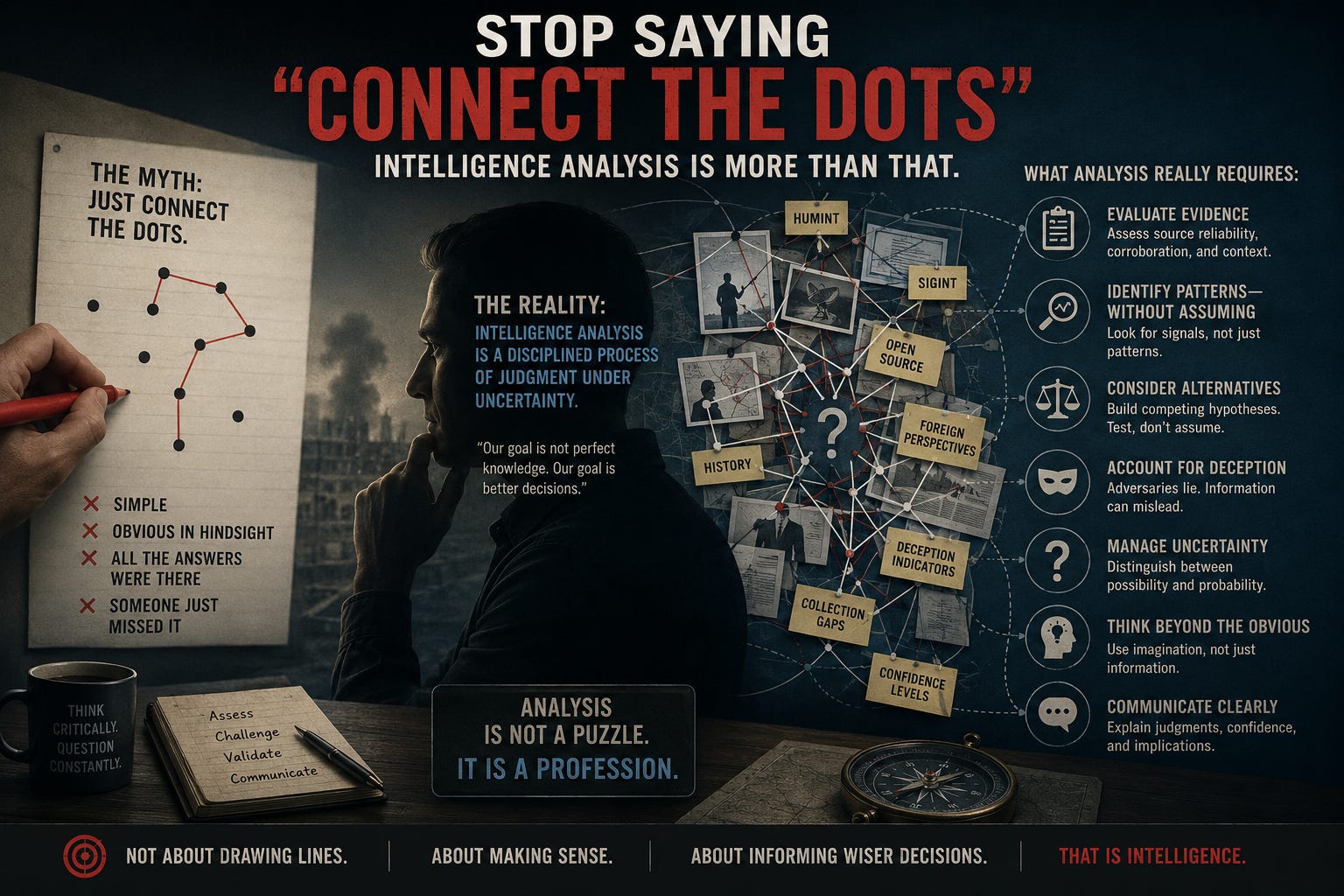
There are few phrases more overused, misleading, and intellectually lazy in discussions of intelligence analysis than “connect the dots.”
It sounds simple. It sounds intuitive. It sounds like the problem of intelligence failure is merely a matter of placing scattered facts on a table and drawing lines between them. One dot here, another dot there, a line between them, and suddenly the truth appears.
That is not intelligence analysis. That is a slogan.
And worse, it is a disingenuous slogan because it reduces one of the most complex cognitive, methodological, and institutional processes in national security to a childlike image of a puzzle already waiting to be solved. It implies that the answer was sitting in plain sight, that all the relevant information was available, that the connections were obvious, and that failure occurred because someone simply neglected to draw the correct line.
That is rarely how intelligence works.
Intelligence analysis is not just about connecting dots. It is about determining which dots are real, which are deceptive, which are irrelevant, which are missing, which are misunderstood, and which only appear meaningful after the fact. It is about making judgments under conditions of uncertainty, ambiguity, denial, deception, incomplete information, bureaucratic pressure, cognitive bias, and time constraints.
To call that “connecting the dots” is not just simplistic. It is misleading.
The Phrase Creates a False Sense of Simplicity
“Connect the dots” assumes the dots are already known, valid, and meaningful.
But in intelligence analysis, the so-called dots are not neatly numbered. They do not arrive in sequence. They are not all visible. They are not all trustworthy. They often come from fragmented reporting, human sources of varying reliability, technical collection with gaps, intercepted communications without context, open-source noise, foreign deception efforts, historical assumptions, and policy demands.
Some “dots” are not dots at all. They are rumors. Some are deliberate fabrications. Some are artifacts of collection bias. Some are true but insignificant. Some are significant but ambiguous. Some only become meaningful when paired with information that has not yet been collected.
The analyst’s task is not merely to draw lines. The analyst’s task is to ask: What am I actually looking at? What is the source? How reliable is it? What are the alternative explanations? What assumptions am I making? What evidence would change my judgment? What am I not seeing? Who benefits if I misread this? What is the adversary trying to hide, distort, or provoke?
That is not dot-connecting. That is disciplined reasoning.
Hindsight Makes Everything Look Obvious
The phrase “connect the dots” is often used after an intelligence failure. After a terrorist attack, military surprise, strategic miscalculation, or political crisis, commentators look backward and say, “The dots were there. Why didn’t they connect them?”
This is hindsight bias wearing a cheap suit.
After an event occurs, the path to that event appears much clearer than it was before the event happened. Information that once looked vague suddenly appears prophetic. Weak signals are reinterpreted as obvious warnings. Isolated fragments become part of a narrative. Noise gets edited out. Competing explanations disappear. The messy uncertainty of the pre-event environment is replaced by the clean storyline of the post-event investigation.
But intelligence professionals do not live in hindsight. They live in the fog before the event.
Before the event, analysts are surrounded by thousands of possible indicators, many of which point in different directions. Threat streams rise and fall. Sources contradict one another. Adversaries adapt. Policymakers ask for confidence levels that the evidence cannot honestly support. Institutions prioritize some threats while underestimating others. Time is limited. Resources are finite.
Afterward, everyone becomes a genius.
That is why “connect the dots” is often unfair. It judges analysts from the privileged position of knowing the ending. It turns uncertainty into negligence and ambiguity into incompetence. Sometimes failure does involve negligence, poor imagination, weak tradecraft, or bureaucratic dysfunction. But the phrase itself does not help us identify those causes. It just flattens everything into a cartoon.
Analysis Is Not Pattern Recognition Alone
There is a dangerous assumption buried inside the phrase: that intelligence analysis is primarily about recognizing patterns.
Pattern recognition matters, of course. Analysts must notice anomalies, correlations, recurring behaviors, shifts in capability, and emerging trends. But pattern recognition is also one of the most dangerous parts of human cognition. The mind sees patterns everywhere, including where none exist.
Bad analysis often comes from connecting too many dots too confidently.
Conspiracy thinking is also dot-connecting. Rumor mills connect dots. Ideologues connect dots. Propagandists connect dots. The problem is not that they fail to connect information. The problem is that they connect information without discipline, proportionality, evidence standards, or competing hypotheses.
Real intelligence analysis requires the restraint to say, “These data points may not belong together.”
That is an underrated analytic virtue.
The mature analyst does not rush to connection. The mature analyst tests connection. The mature analyst asks whether the relationship is causal, coincidental, temporal, operational, strategic, or imagined. The mature analyst distinguishes between possibility and probability. The mature analyst knows that a persuasive narrative is not the same thing as a sound judgment.
In this sense, intelligence analysis is not merely the construction of meaning. It is also the disciplined prevention of false meaning.
The Phrase Undervalues Uncertainty
The public often wants intelligence to provide certainty. It wants clear warnings, clean answers, and confident predictions. But intelligence analysis is not prophecy. It is judgment under uncertainty.
That judgment must account for confidence levels, source reliability, evidence gaps, adversary intent, alternative scenarios, and the consequences of being wrong. Analysts are not simply asked, “What happened?” They are asked, “What is likely to happen? Why? How confident are we? What could change the assessment? What indicators should we monitor? What are the implications?”
That is a different intellectual task from connecting dots.
A dot-connecting metaphor makes intelligence sound like a visual puzzle. But a better description would involve probability, inference, hypothesis testing, structured skepticism, and decision support. Intelligence analysis is not about producing perfect knowledge. It is about reducing uncertainty enough to help decision-makers act more wisely.
That distinction matters.
When people say “connect the dots,” they often imply that the correct answer was certain if only someone had looked carefully enough. But many intelligence problems do not offer certainty. They offer degrees of plausibility. They offer warning signs, not guarantees. They offer fragments, not full pictures. They offer adversaries who are actively trying to prevent understanding.
The analyst’s job is not to pretend the picture is complete. The analyst’s job is to communicate what can be known, what cannot yet be known, and what must be watched closely.
Intelligence Analysis Requires Imagination, Not Just Information
Another weakness of the phrase is that it focuses too much on existing information. It suggests that once enough dots are collected, the answer emerges.
But intelligence failures are often failures of imagination as much as failures of information.
Analysts and institutions must imagine how an adversary might think, adapt, deceive, exploit vulnerabilities, or break from historical patterns. They must consider low-probability, high-impact events without becoming alarmist. They must challenge mirror imaging. They must ask whether the adversary sees the world differently. They must think beyond doctrine, beyond precedent, beyond what seems rational from their own cultural or institutional perspective.
This is hard work.
It requires intellectual humility. It requires red teaming. It requires structured analytic techniques. It requires discomfort. It requires the courage to challenge consensus and the discipline not to mistake speculation for assessment.
“Connect the dots” does not capture any of that.
It makes analysis sound mechanical when it is deeply cognitive. It makes judgment sound obvious when it is often contested. It makes warning sound easy when warning is one of the hardest tasks in the intelligence profession.
The Phrase Encourages Blame More Than Learning
The most serious problem with “connect the dots” is that it often becomes a tool of blame rather than understanding.
After a failure, people want accountability. That is legitimate. Intelligence organizations should be scrutinized. Assumptions should be examined. Collection gaps should be identified. Coordination failures should be exposed. Analytic standards should be improved.
But serious review requires serious language.
“Connect the dots” does not diagnose failure. It does not tell us whether the problem was collection, analysis, dissemination, imagination, prioritization, leadership, interagency coordination, policy pressure, legal constraint, technological limitation, or cognitive bias. It does not distinguish between unavailable information and ignored information. It does not distinguish between weak signals and clear warnings. It does not distinguish between analytic error and decision-maker failure.
It just says: someone should have seen it. That may feel satisfying, but it is not enough.
If we want better intelligence, we need better criticism. We need to ask sharper questions. Were assumptions made explicit? Were alternative hypotheses considered? Was dissent encouraged? Were warnings communicated clearly? Were confidence levels appropriate? Were collectors and analysts integrated effectively? Did policymakers understand the limits of the assessment? Did institutional incentives reward caution, conformity, or intellectual courage?
Those questions improve the system. “Connect the dots” does not.
A Better Way to Talk About Intelligence Analysis
We should retire the phrase, or at least stop treating it as a serious description of analytic work.
Instead of saying analysts need to “connect the dots,” say what the work actually requires.
They must evaluate evidence.
They must test assumptions.
They must identify patterns without becoming prisoners of pattern-seeking.
They must weigh competing hypotheses.
They must distinguish signal from noise.
They must account for deception.
They must communicate uncertainty.
They must challenge institutional comfort.
They must warn without overstating.
They must think with rigor, humility, and imagination.
That is intelligence analysis.
The goal is not to draw a neat line between scattered facts. The goal is to produce the most accurate, useful, and honest judgment possible in an environment where the truth is partial, contested, hidden, and often deliberately manipulated.
That is far more demanding than “connecting the dots.”
The Bottom Line
“Connect the dots” is a phrase that comforts outsiders because it makes intelligence failure look simple. But intelligence analysis is not simple. It is not a children’s puzzle. It is not merely an exercise in linking obvious clues.
It is a disciplined struggle against uncertainty.
It is the art and science of making sense of incomplete, ambiguous, and sometimes deceptive information. It requires skepticism, imagination, methodological rigor, historical knowledge, cultural understanding, humility, and courage.
So let’s stop saying “connect the dots” as if that explains intelligence analysis.
It does not.
It trivializes the craft. It distorts the problem. It encourages hindsight arrogance. And it insults the complexity of a profession built around one of the hardest tasks in human judgment: seeing clearly before events become obvious.
Absolutely, Dr. Russo. Here are polished sections you can add to the article.
Recommendations
First, intelligence professionals, educators, journalists, and policymakers should stop using “connect the dots” as a serious description of intelligence analysis. The phrase may work as casual shorthand, but it does not accurately represent the analytic process. It oversimplifies the work, misleads the public, and encourages hindsight-driven criticism after failures. Language matters. If we want people to understand intelligence analysis better, we need to describe it with greater precision.
Second, analysts and intelligence educators should emphasize that analysis is a disciplined process of judgment under uncertainty. The work involves evaluating evidence, questioning assumptions, identifying gaps, weighing alternative hypotheses, assessing source reliability, and communicating confidence levels. These are not minor details. They are the foundation of sound analytic tradecraft.
Third, intelligence organizations should continue strengthening structured analytic techniques that help analysts resist premature conclusions. Tools such as Analysis of Competing Hypotheses, key assumptions checks, red teaming, indicators and warnings frameworks, and devil’s advocacy help prevent analysts from forcing weak or unrelated information into a preferred narrative. Good analysis is not about making the story fit. It is about testing whether the story deserves to survive scrutiny.
Fourth, leaders and decision-makers should be educated on the limits of intelligence. Intelligence is not prediction with a badge. It is not certainty. It is not a crystal ball. Decision-makers need to understand probability, confidence, ambiguity, deception, and collection gaps. When intelligence judgments are treated as guaranteed answers, both analysts and policymakers are set up for failure.
Fifth, post-event reviews of intelligence failures should move beyond simplistic claims that “the dots were there.” Serious reviews should ask harder questions: Was the information credible? Was it properly shared? Were alternative explanations considered? Were warnings clear? Were assumptions challenged? Were institutional incentives encouraging conformity or candor? Was the failure analytic, operational, bureaucratic, political, or some combination of these? Accountability requires precision, not slogans.
Finally, the public conversation about intelligence analysis needs to mature. Intelligence work deserves criticism, but it also deserves to be understood. Reducing analysis to “connecting the dots” may sound clever, but it hides the real challenge: making responsible judgments in an environment shaped by uncertainty, deception, incomplete information, and human bias. We should demand better analysis, but we should also demand better language when describing it.
Conclusion
The phrase “connect the dots” should be retired from serious discussions of intelligence analysis. It is too simplistic for the complexity of the craft and too misleading for the consequences involved. Intelligence analysis is not the act of drawing obvious lines between obvious facts. It is the disciplined evaluation of uncertain, incomplete, and often deceptive information in pursuit of sound judgment. Analysts must question what is known, confront what is unknown, challenge assumptions, consider alternatives, and communicate uncertainty with intellectual honesty. That is not a puzzle. That is a profession. And if we want to improve intelligence analysis, we must begin by speaking about it with the seriousness it deserves.
Author Bio
Dr. Russo is a keynote speaker, educator, author, philosopher, and intelligence analyst whose work focuses on critical thinking, intelligence analysis, metacognition, education, national security, homeland security, criminal justice, and terrorism. He brings an interdisciplinary perspective to complex security and decision-making challenges, emphasizing intellectual humility, analytic rigor, and the disciplined evaluation of evidence. Through his writing, teaching, and speaking, Dr. Russo encourages professionals and students to think more clearly, question more deeply, and approach uncertainty with courage, precision, and responsibility.
Disclaimer
The views expressed in this article are those of the author and are intended for educational, professional development, and commentary purposes only. They do not represent the official position of any government agency, academic institution, employer, or professional organization. This article does not disclose classified, sensitive, or operational information. Its purpose is to encourage clearer thinking, stronger analytic tradecraft, and more responsible public discussion about intelligence analysis.
Recommended Readings and Resources
Readers who want to move beyond slogans and understand intelligence analysis as a disciplined form of judgment should explore Dr. Charles M. Russo’s broader body of work on analytical integrity, critical thinking, intelligence education, philosophy, law enforcement, homeland security, and national security. His official research and publications page identifies a wide range of books, articles, presentations, podcasts, and academic work connected to intelligence analysis, criminal justice, public safety, and higher education. (Dr. Charles M. Russo)
Recommended Books by Dr. Charles M. Russo
Safeguarding Analytical Integrity: Why Political Ideology Must Be Excluded from Intelligence Analysis should be read as a direct companion to this article. It addresses flawed reasoning, bias, political distortion, analytic standards, structured analytic techniques, transparent writing practices, and review mechanisms. For readers serious about intelligence tradecraft, this book provides a deeper argument for why objectivity must be engineered, not merely assumed. (Apple)
Precision in Perspective: Critical Thinking for Analytical Minds: The Art of Critical Thinking to Transform Your Analytical Mindset is recommended for students, analysts, educators, researchers, and leaders who want to strengthen their reasoning habits before they enter the complexity of intelligence analysis. The book focuses on philosophy, logic, psychology, bias, decision-making, argument formation, and analytical mindset development. (Everand)
100 Stoic Lessons for Overcoming Life’s Challenges is recommended for readers who want the philosophical foundation beneath disciplined judgment. Intelligence analysis requires more than technique; it requires self-command, patience, restraint, intellectual courage, and the ability to respond wisely under pressure. This book applies Stoic wisdom through moral lessons and reflective questions aimed at resilience, self-control, patience, courage, and better thinking. (Rakuten Kobo)
Selected Publications and Articles
Readers interested in the philosophical foundations of critical thinking should begin with “Between Assent and Dissent: Why Studying Stoicism and Cynicism Strengthens Critical Thinking and Cognitive Development.” The article argues that Stoicism trains disciplined assent, while Cynicism trains principled dissent—two habits of mind essential for resisting premature judgment and inherited opinion. (Dr. Charles M. Russo)
Readers interested in artificial intelligence and intelligence education should read “Testing the Adjudicative Intelligence Model: An Empirical Study of AI-Mediated Cognition in Intelligence Education.” The article examines AI-assisted analysis, automation bias, cognitive independence, analytic tradecraft, metacognition, and decision-making under uncertainty. (Dr. Charles M. Russo)
Readers interested in society’s failure to cultivate serious thinking should read “Systemic Constraints on Intelligence: Why Contemporary Society Fails to Nurture Critical Thought.” This work connects intelligence, education, institutional design, and the cultural conditions that shape or weaken critical reasoning. (LinkedIn)
For readers focused on criminal justice and national security analysis, recommended articles include “Crime Analysts and Intelligence Analysts,” “25 Years of Lone Offenders in America,” and “Ethics in Law Enforcement and Intelligence.” These pieces extend the discussion into intelligence-led policing, lone-offender violence, ethics, law enforcement, and public safety analysis. (Safety & Emergency Services Journal)
For readers who want a scholarly intelligence tradecraft piece, “Analytical Standards in the Intelligence Community: Are Standards Professionalized Enough?” is also recommended. Dr. Russo’s research/publications page lists this 2021 article in the Journal of Strategic Security, coauthored with Derek Reinhold and Dr. Beth Eisenfeld. (Dr. Charles M. Russo)
Where to Follow Dr. Russo’s Work
For ongoing essays, white papers, and long-form commentary, readers should follow Dr. Charles M. Russo on Substack, where his work appears under themes of critical thinking, intelligence analysis, philosophy, education, and disciplined judgment. His Linktree/resource hub lists Substack among his primary platforms, and several recent articles are published through his Substack site. (Linktree)
For video-based education and public-facing commentary, readers can follow The Vested Professor on YouTube. Dr. Russo’s official website lists monthly “Doctorate and Dissertation Tips”on hise YouTube channel, and his Linktree identifies YouTube as one of his active platforms. (Dr. Charles M. Russo)
For professional updates, speaking information, academic commentary, and public engagement, readers can connect with Dr. Russo through LinkedIn, Instagram, Threads, TikTok, and his official website. His Linktree identifies these platforms and also links to his website, books, Substack, and The Analytical Edge Academy. (Linktree)
For speaking engagements, publications, presentations, research, and professional background, readers should visit Dr. Charles Russo’s official website. The site includes pages for speaking, writing, opportunities, certifications, academia, presentations, and research/publications. (Dr. Charles M. Russo)
Condensed Version for the Article
For readers who want to go deeper, Dr. Charles M. Russo’s books and publications offer a broader framework for understanding intelligence analysis, analytical integrity, critical thinking, philosophy, and disciplined judgment. Recommended works include Safeguarding Analytical Integrity: Why Political Ideology Must Be Excluded from Intelligence Analysis, Precision in Perspective: Critical Thinking for Analytical Minds, and 100 Stoic Lessons for Overcoming Life’s Challenges. Readers may also explore his Substack essays on Stoicism, Cynicism, artificial intelligence, intelligence education, and critical thinking, along with his articles on intelligence standards, crime analysis, lone-offender violence, and ethics in law enforcement and intelligence. For current publications, speaking information, videos, and professional updates, readers can visit Dr. Russo’s official website (Dr. Charles M. Russo) and follow his work through Substack, YouTube, LinkedIn, Instagram, Threads, TikTok, and his central Linktree resource hub.
AWESOME!! I couldn't agree more! In fact, I agreed in advance - I hit the same sugject a little while ago ... just not as well, or in as much depth.
Thank you for foot stomping this!
https://www.linkedin.com/posts/jeremy-levin-training_connecting-the-dots-activity-7416501174155141120-MNrJ?
Strong perspective. Critical thinking matters far more than simply connecting the dots.